HSC English · Study article
One Night the Moon HSC Analysis: Verified Scenes, Themes and Music
A scene-based guide to Rachel Perkins' film: the search for Emily, competing relationships with Country, musical storytelling and HSC essay arguments.

On this page
Rachel Perkins' One Night the Moon (2001) explores a family's loss through a conflict over who belongs on, understands and can speak for a particular place. When Emily Ryan disappears, her father Jim refuses the help of Aboriginal tracker Albert. His decision turns racial prejudice into an obstacle within a desperate search. Rose, Emily's mother, later approaches Albert. Their cooperation exposes an alternative to Jim's refusal without proving that he changes his beliefs.
For 2027–2030 HSC English Standard and Advanced, the film is prescribed for Texts and human experiences. Its value for an essay lies in how Perkins tells this story: the landscape's prominence, the exclusion made clear in the NFSA search extract, contrasting songs and the later joining of Rose and Albert's voices connect private grief with social power. The NESA prescriptions list also places the film in English Studies, where the focus area is separately named Narrative and human experiences.
Film overview
- Film
- One Night the Moon (2001), a short Australian musical drama made for television
- Setting and HSC placement
- Set in 1930s outback Australia and filmed in the Flinders Ranges; prescribed for 2027–2030 English Standard and Advanced, Texts and human experiences
The film and setting details come from Screen Australia's film record; the HSC placement is listed in NESA's prescriptions. Perkins' story draws on events involving a real Aboriginal tracker, but the film is a constructed drama, not a documentary record of every event.
One Night the Moon plot summary
The disappearance
The film first presents the Ryan home as a place of parental closeness. Emily sings a lullaby with Rose, and Jim joins them. Later, drawn by the moon, Emily leaves the farmhouse through a window. Rose discovers she is gone. The early song matters because its reassurance becomes painful in retrospect: the family cannot protect the child it has just sung to. The NFSA description of the opening extract verifies the family singing together; Screen Australia's synopsis confirms Emily's departure and disappearance.
A search shaped by exclusion
Police and volunteers gather at the Ryans' property. Albert, an Aboriginal tracker recommended for the search, arrives, but Jim rejects his participation and asserts authority over “his” land. The search party moves out without Albert. The production's published shooting-script extract shows another officer warning that the large party will obliterate tracks; the NFSA search extract confirms Albert is excluded as Jim and the men begin searching. Thus the harm is more precise than a broad claim that Jim is prejudiced: he removes expertise when it is most needed.
Different responses to loss
Jim persists in a search he tries to direct. Rose lives with Emily's absence and later seeks the help Jim refused. Albert remains outside the official search, though his knowledge of the country is the very skill the family needs. Perkins gives the three adults different positions in relation to Emily and the landscape: Jim attempts to command, Rose comes to seek help, and Albert can read signs that the search party has failed to respect. These are analytical descriptions of their contrasting actions, not claims that every thought is spoken aloud.
Rose and Albert's shared search
In the later extract known as “Unfinished Business”, Rose begins singing on the porch, approaches Albert as he chops wood, and their voices join as they follow what they believe to be Emily's route. The NFSA's account identifies this as the beginning of the climax, not its resolution. Their cooperation gives a concrete alternative to Jim's exclusion. The available extract does not establish what the finished film finally shows about Emily or Jim, so this guide makes no claim about the final sequence.
Character analysis
Jim Ryan
- Narrative role and central conflict
- Emily's father tries to protect her while defending his property and authority. His rejection of Albert removes tracking expertise from the search and creates a conflict with Rose over whom to trust.
- Film or music evidence
- At the assembled search, he sends Albert away; “This Land Is Mine/This Land Is Me” sets his ownership claim against Albert's reply.
- Adaptable argument
- Perkins shows how a sincere sense of family duty can coexist with a destructive refusal to recognise another person's knowledge.
Rose Ryan
- Narrative role and central conflict
- Emily's mother moves from the enclosed family home and anxious waiting towards collaboration with Albert. Her later decision to search with Albert shows a change in whom she is willing to trust.
- Film or music evidence
- The opening lullaby establishes family intimacy; in “Unfinished Business” her song meets Albert's and the two search together.
- Adaptable argument
- Rose's developing response makes empathy an action, without proving that the family or community has overcome its prejudice.
Albert
- Narrative role and central conflict
- The tracker knows how to search this country but is denied authority by Jim and the police-led party. His expertise and his relation to place are central, not a convenient rescue device.
- Film or music evidence
- He is left outside the first search; his musical response in the land sequence speaks of identity and belonging; he later joins Rose.
- Adaptable argument
- Perkins contrasts institutional exclusion with situated knowledge, asking whose experience a community chooses to value.
Emily
- Narrative role and central conflict
- The lost child connects the adults' intimate lives to the search. Her vulnerability gives their decisions immediate stakes.
- Film or music evidence
- She sings with her parents before leaving the window; the search continually returns to her absence.
- Adaptable argument
- Emily's disappearance exposes both love's limits and the cost of prejudice without making her a simple symbol for the land.
Albert's surname appears inconsistently across secondary accounts, so this article uses Albert. The NFSA/Australian Screen curator calls him Albert Riley; the published shooting script identifies the character simply as Albert. Avoid attaching a different surname to the film character without checking the screen credits.
Jim Ryan: love constrained by authority
Jim's urgency as Emily's father makes his decision to exclude Albert more troubling, because the search is an act of care as well as an assertion of control. The NFSA extract describes the men gathering to search while Jim sends Albert away; the published script places Jim on the verandah. The script's spatial direction suggests a way to read the power of the landholder, but it should not be presented as a verified camera composition. In the land song, his vocal claim to ownership continues the same idea through music. An essay can argue that Perkins asks viewers to recognise Jim's fear without treating fear as an excuse for the knowledge he rejects.
Rose Ryan: grief and a changed relationship
The lullaby first positions Rose within a close family group; Emily's absence then changes the meaning of that sound. Rose's later movement from the verandah towards Albert in “Unfinished Business” gives her developing trust an observable action, not simply a change in stated opinion. When their voices join, the soundtrack makes cooperation audible. Her relationship with Jim remains under pressure, while her search with Albert offers a different response to their daughter's disappearance. Their cooperation does not itself prove that the earlier prejudice is repaired.
Albert: expertise denied, perspective heard
Albert's ability to track is recognised by the police process, but Jim's refusal prevents him from joining the first search. The NFSA extract establishes the contrast between the assembled searchers and Albert, who is not permitted to join them. The published script adds a direction that leaves him by a fence; that detail requires a final-film check before it becomes shot analysis. His answer in the land song then lets viewers hear a relationship to place that Jim's property language cannot contain. Perkins does not make Albert merely an instrument for the Ryan family's learning: his expertise, exclusion and later decision to help Rose give him a consequential position in the story.
Emily: presence, absence and narrative stakes
Emily is present in the opening family song before her disappearance reorganises every adult relationship. The window through which the opening viewpoint enters the home is also associated with her departure, so a place of intimacy becomes a reminder of its limits. The distant image of her crossing the landscape, described by Richards, sets a child's vulnerable scale against a much larger environment. In an essay, keep Emily a child within the narrative rather than reducing her to a symbol: the force of the film's social conflict depends on the search for her being urgent and real.
Major themes and human experiences
Racism, power and colonial attitudes
Jim's refusal at the search assembly is both an expression of racism and an exercise of local power. Albert arrives through the police process, but Jim's claim to decide who may enter his property prevails; the sergeant lets the search proceed without the tracker. The published script and NFSA extract allow a sharp argument: prejudice changes what the group can know and do. The threatened destruction of tracks turns a social hierarchy into material harm. An essay can analyse the contrast between Jim's asserted authority and the loss of the very evidence Albert could read.
Country, land and belonging
The Flinders Ranges do more than provide scenery. Perkins and cinematographer Kim Batterham deliberately made the landscape central to the drama, according to Australian Screen curator Romaine Moreton. Jim's land song connects place to title, work, fences and a fear of dispossession. Albert's reply connects it to identity and generations of relationship. The two views sound across the same terrain, so ownership is made to seem like one cultural claim among others rather than an unquestioned fact. Albert's perspective belongs to this character and film; it should not be used as a blanket account of all Aboriginal peoples' relationships with Country.
Grief, mortality and family
The opening family lullaby establishes love before the search begins. Its emotional force later depends on Emily's absence. Jim and Rose both want their daughter found, but they act differently under pressure: his rigid control increases isolation, while her eventual request for help opens a relationship with Albert. The uncertainty surrounding Emily makes mortality a pressure on every decision. The verified search scenes refuse the comforting claim that a loving intention cancels the effects of excluding needed knowledge.
Identity and conflicting perspectives
Jim's confidence as father and landholder is tested by a landscape and a tracker he cannot command. Albert's expertise remains real even when the search party denies it. Rose's movement towards Albert shows that a perspective can change, but only through a difficult recognition of another person's knowledge. These positions make identity a matter of relationships and actions, not just a label a character announces.
Cooperation, with limits
Rose and Albert's joined voices and shared search offer a possibility of understanding. Their cooperation is concrete, yet it follows the first search's rejection of Albert. It would be premature to call this a reconciliation of the whole community or a transformation in Jim. A strong essay can analyse the contrast between these two responses without claiming that a shared song reverses the harm of the earlier exclusion.
Individual and collective experience
Emily's disappearance is personal to the Ryans, but the volunteer search, police decisions and treatment of Albert make it collective. The film asks viewers to connect one family's suffering with a wider distribution of authority. The same event is experienced differently by Jim, Rose and Albert because social position affects whose knowledge is heard and whose loss is publicly recognised.
Film techniques: how Perkins creates meaning
The analysis below names the three NFSA extracts, the published shooting-script extract or a critic when describing a formal detail. The script is evidence of an intended scene, not proof of the finished edit or shot. Students should confirm such details against the version they study.
Opening: point of view and framing
- Observable choice
- The NFSA describes a viewpoint moving from outside the homestead through a window to Emily and Rose on a bed; Jim enters and joins the lullaby.
- Effect and essay-ready interpretation
- The movement draws viewers into an intimate family space before that same window becomes associated with Emily's disappearance. Domestic safety becomes fragile rather than guaranteed.
Emily's departure: long view and tonal contrast
- Observable choice
- Ruth Richards' film analysis describes Emily in a white nightdress, seen at a distance crossing the landscape with gentle music.
- Effect and essay-ready interpretation
- The child's small scale and inviting sound resist immediate horror; the later parental discovery makes the earlier serenity disturbing. This is a contrast between a child's attraction and adult fear.
Search assembly: exclusion and performance
- Observable choice
- The NFSA extract describes the searchers assembling while Jim demands that Albert leave. Albert does not join the search.
- Effect and essay-ready interpretation
- The contrast between the organised group and the excluded tracker exposes how Jim's local authority overrides Albert's expertise. Do not infer a specific camera angle from the script.
Search method: dramatic irony
- Observable choice
- Screen Australia's synopsis states that the search stamps out tracks; the published script contains a warning about that risk. These sources do not establish an exact shot of the volunteers' feet.
- Effect and essay-ready interpretation
- The searchers' activity can work against the search itself. Their reliance on collective authority becomes bitterly ironic beside their rejection of a tracker.
Land song: musical counterpoint
- Observable choice
- The NFSA extract describes Jim beginning the land song and Albert joining the song while remaining outside the search.
- Effect and essay-ready interpretation
- The two vocal claims to the same place are heard together even as one singer is excluded from the group. A specific pattern of cuts or camera positions still needs film verification.
Land song: sound and instrumentation
- Observable choice
- The NFSA's music analysis identifies European violins with Jim's song and a didgeridoo with the tracker's.
- Effect and essay-ready interpretation
- Instrumental contrast makes cultural difference audible. Avoid claiming that a single instrument represents every Aboriginal or settler tradition; discuss its role in this particular soundtrack.
“Unfinished Business”: vocal joining and narrative movement
- Observable choice
- The NFSA describes Rose singing on the porch, moving towards Albert, and his song joining hers as they walk in Emily's path.
- Effect and essay-ready interpretation
- Sound accompanies changed action. Their shared purpose can be heard while the search remains unresolved in the extract.
Lighting and colour need the same precision. Richards identifies warm candlelight and star-and-moon decoration in Emily's bedroom before she goes missing. Read the warmth as a constructed sense of shelter, then compare it with her distant figure outdoors. Do not invent a colour scheme for later scenes you have not checked. Silence and dialogue also require care: the script gives Albert a silent response after his exclusion, followed by the land song that articulates what he cannot make the search party hear. That contrast is stronger than a generic claim that the whole film is silent.
Starting point
Developed argument
Music and musical storytelling
One Night the Moon was conceived with songs as part of its narrative structure. In a filmmaker interview, Perkins explains that songs shaped the rhythm and action of scenes. Music therefore carries perspective and feeling; it is not merely background added after the story has been told.
The family lullaby
- Verified placement and form
- Emily, Rose and Jim sing together in the opening bedroom extract; the NFSA credits Paul Kelly with writing that lullaby.
- Meaning to develop
- Shared singing creates intimacy, making later absence and grief more acute.
Jim's land claim
- Verified placement and form
- At the search's start, Jim begins “This Land Is Mine/This Land Is Me” while the volunteers assemble; the NFSA identifies violins in his musical strand.
- Meaning to develop
- The song places property, labour and control inside his own voice, rather than asking viewers to accept his claim as neutral narration.
Albert's answer
- Verified placement and form
- Albert joins the same sequence after being excluded, but not the search. The NFSA identifies didgeridoo in his strand.
- Meaning to develop
- Musical counterpoint gives excluded knowledge an audible presence and places belonging beside possession.
Rose and Albert's joined song
- Verified placement and form
- In “Unfinished Business”, her voice meets his and the two move together to look for Emily.
- Meaning to develop
- Their shared sound accompanies a changed relationship, while the unresolved search keeps the moment emotionally tense.
The published script for the land-song sequence credits Kev Carmody and Paul Kelly for that song's music and lyrics. The film's principal credits list Paul Kelly, Kev Carmody and Mairead Hannan for music across the film. Those are different levels of attribution: do not assign every song to one composer, or infer from the score who performs each vocal. The scene's key contrast can be expressed without reproducing its lyrics: Jim claims to own land; Albert sings of a relationship in which land constitutes and claims him.
The form also complicates who can speak. Jim commands the volunteers, yet Albert's musical answer reaches the audience even when the search excludes him. Later, Rose's melody joining Albert's gives cooperation a shape that ordinary dialogue alone might not provide. The NFSA's music essay describes this as a cinematic opera; for an HSC response, the useful point is the precise interplay of voice, image, instrumental colour and dramatic action.
One Night the Moon and Texts and human experiences
NESA's current English Standard and English Advanced syllabuses call the Year 12 focus area Texts and human experiences. The film lets you examine a personal experience of parental fear, grief and guilt alongside a collective experience: a search organised through social assumptions about race, land and authority. “Common Module” may appear in older materials, but use the current focus-area name when describing the 2027 course.
Look for contradictions in behaviour rather than announcing a theme. Jim loves Emily and wants to save her, yet rejects a person who might help. Rose's love does not instantly free her from the family's assumptions, but grief eventually prompts her to act differently. Albert is both recognised as a tracker by the police and denied a place in the actual search. These tensions show how culture and institutions influence responses to suffering.
Perkins also shows that storytelling constructs perspective. The opening lullaby grants access to family intimacy; the counterpoint song grants access to conflicting ideas about land; the later duet makes a possible connection audible. Explain how each formal choice invites viewers to question their first assumptions. For another prescribed work in which place and displacement shape human experience, compare our An Imaginary Life analysis; for a different Australian landscape and social world, see our Henry Lawson short-stories guide.
Developing an essay argument
Perkins exposes how entrenched prejudice can survive an experience of profound parental fear, revealing the disturbing coexistence of love and racial exclusion. When Emily disappears, Jim rejects Albert, the Aboriginal tracker whose expertise could assist the search. The men assemble without him; as their search damages the tracks he might have read, Jim's claim to authority threatens the very aim of recovering his daughter. That bitter dramatic irony gives his prejudice practical force. Perkins deepens the conflict through the musical counterpoint of This Land Is Mine/This Land Is Me: the opposition between “mine” and “me” sets Jim's possessive view of land against Albert's understanding of Country as part of identity. Albert's voice reaches the audience even as Jim denies him a place in the search, making the exclusion of Indigenous knowledge audible as well as consequential. Jim's paternal attachment cannot excuse his refusal to recognise another way of knowing the landscape. By allowing a desperate search to proceed under the authority of that prejudice, Perkins challenges the comforting assumption that suffering inevitably deepens empathy or loosens inherited beliefs.
For a method of turning a precise technique into an argument, see our HSC English literary techniques guide.
Final takeaways
Sources and evidence limits
The NESA prescriptions establish course placement. Film facts and the three extract descriptions come from Screen Australia and NFSA/Australian Screen. The published shooting-script extract, Perkins' interview, NFSA music analysis and Ruth Richards' scene analysis support the formal readings. This guide was researched from those materials; it does not claim a complete first-hand viewing of the film. Its final sequence and any claims about Jim's fate or recognition still require verification against an authorised copy. Check any shot-level claim against your class's copy.
HSCAssociate Platform
HSCAssociate Platform · Writing practice
Preparing Your One Night the Moon HSC Essay?
Don't just memorise your analysis. Put it into practice with HSCAssociate.
Essay Marker
Submit HSC English essays and receive detailed feedback to improve your response.
English Essay Builder
Develop your thesis, structure your arguments and prepare for unfamiliar HSC questions.
One Night the Moon HSC Study Guide
The matching HSCAssociate Library study guide develops the film's ideas, form and essay planning in more depth. Its Library page shows the current access options. Use it alongside a viewing of the film and your own scene notes.
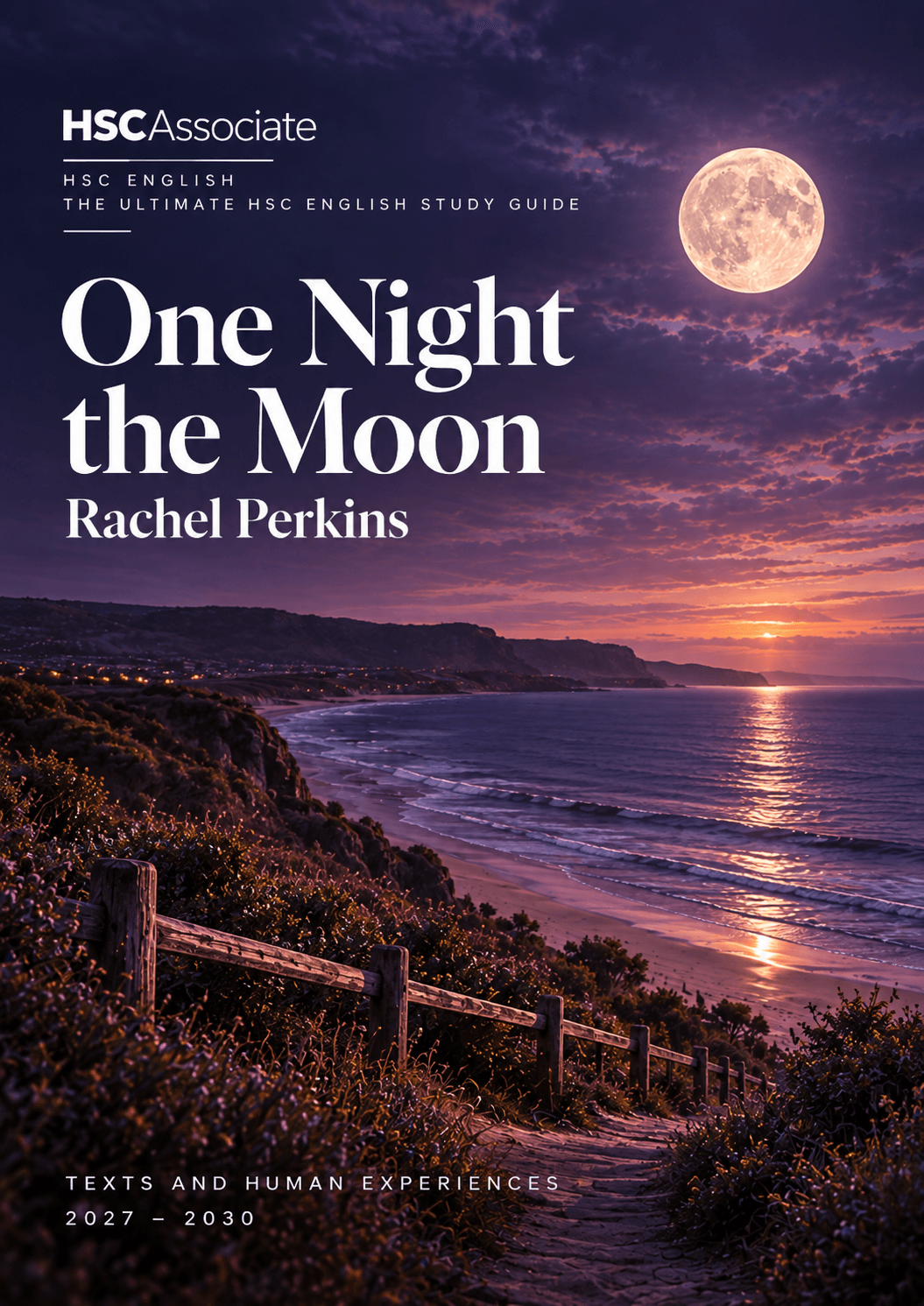
The matching HSCAssociate study guide
Explore the One Night the Moon HSC Study Guide
Study how the film's treatment of Country, loss, recognition, racism and belonging works through its musical and visual form.
- Connect film and musical form to the ideas you discuss.
- Develop an argument rather than recounting scenes.
- Select evidence that makes your interpretation specific.
Purchase and existing Reader access are handled on the study-guide page.
Frequently asked questions
What is One Night the Moon about?
Rachel Perkins' musical drama follows Jim and Rose Ryan after their daughter Emily disappears into the outback. Jim rejects Aboriginal tracker Albert's help; Rose later searches with Albert. The disappearance exposes how prejudice can obstruct care and how people understand land and loss differently.
What are the main themes in One Night the Moon?
Racism, Country and belonging, grief, family and authority are central. The search scenes join the Ryan family's personal fear to inequalities in whose knowledge is trusted. Rose and Albert's later cooperation offers a limited contrast to Jim's refusal, without proving that he changes.
How is racism represented in One Night the Moon?
Jim bars Albert from the search despite the tracker's expertise. The men's search then destroys traces Albert might have read. The scene shows prejudice as a decision with practical consequences, reinforced by Jim's claim of ownership in song.
What does the landscape symbolise in One Night the Moon?
The Flinders Ranges are the physical setting of Emily's disappearance and a contested place of knowledge and belonging. Jim sings of possession, while Albert's musical response connects place to identity and generations of relationship.
How does Rachel Perkins use music to represent human experiences?
The opening family lullaby makes Emily's loss more painful; Jim and Albert's contrasting song voices competing relationships with land; Rose and Albert's later shared song makes cooperation audible without undoing Jim's earlier exclusion.
How should I build an essay on One Night the Moon?
Answer the specific question with a qualified thesis and distinct arguments. Analyse the verified NFSA extracts and musical contrast, explain how exclusion affects the search, and distinguish the script's directions from final-film observations. Do not infer Jim's change of mind from grief alone.