HSC English · Study article
Gwen Harwood: HSC Poetry Summary, Themes and Analysis
A clear guide to Gwen Harwood's seven prescribed poetry selections for 2027–2030 HSC English, their distinct concerns and the human experiences that connect them.
On this page
Gwen Harwood Poetry Overview
Gwen Harwood's poems can move from a child's bedroom to a parent's final years, or from a remembered flower to a question about what language can express. Harwood (1920–1995) is a major Australian poet whose work brings domestic life, music, philosophy and religious imagery into conversation. Her speakers often discover that growing older changes the meaning of what they once thought they knew.
For 2027–2030 HSC English, seven selections from Selected Poems are prescribed for Texts and human experiences in both English Standard and English Advanced. Read them as distinct poems with recurring concerns: relationships, memory, agency, love and mortality do not carry the same emotional weight in every work.
Her tonal range matters: affection can sit beside anger, wit beside grief, and an apparent moment of peace beside an awareness that it will end. Begin with each poem's concrete situation before connecting it to larger ideas about innocence, loss or time.
The NESA 2027–2030 prescriptions specify Gwen Harwood's Selected Poems (Penguin Books, 2001, ISBN 9780141006680). The prescribed selections are the seven below; “Father and Child, I and II” is one two-part selection, with “Barn Owl” and “Nightfall” both required.
Summary of the Prescribed Poems
The Glass Jar
A boy leaves a glass jar in the sun, hoping it will hold enough light to protect him through the night. The plan fails. Frightened, he seeks his mother, whom he imagines as a comforter, but perceives his father as a rival when he encounters his parents together. The poem presents this disturbing scene through the child's limited understanding, rather than establishing his fearful reading as objective fact. The jar makes an impossible wish tangible: to keep daylight, certainty and childhood safety from passing. The movement from hope to disillusionment differs from the deliberate act of harm in “Barn Owl”; here, the child first tries to defend himself against what he cannot control.
The Violets
Violets draw an adult speaker into a childhood memory of being distressed that daylight has gone. Her mother comforts her, and the recollection opens onto a warmly observed family scene. The flower links present and past, but it does not return the lost hours. The poem holds consolation and grief together: memory preserves tenderness while making time's passage more acute. Unlike the abrupt discovery in “The Glass Jar”, understanding here arrives through the adult speaker's return to an earlier self.
At Mornington
The speaker remembers being caught by a wave as a very young child and believing she could walk on water. In the present, she stands with a friend near the graves of his parents. Water, light and remembered places connect childhood confidence with a middle-aged awareness of death. What matters is the shared day they still have. The poem does not claim that friendship defeats mortality; it shows how companionship can make a finite moment precious.
Father and Child, I and II
I. “Barn Owl.” A child takes the father's gun and shoots an owl, imagining an act of mastery. Faced with the wounded bird's suffering, the child discovers that causing death is nothing like possessing an abstract power over it. The father makes the child confront the consequences. The movement from defiance to horror gives childhood “innocence” a troubled meaning: the child is capable of cruelty and of moral awakening.
II. “Nightfall.” Decades later, the child is an adult walking with the ageing father. The prospect of his death changes the earlier balance between them. The parent who once guided the child cannot be protected from time, and their walk becomes an act of attention to each other. Read together, the two parts turn the death of the owl into a distant but painful prelude to a more intimate understanding of mortality.
A Valediction
A speaker facing separation from her lover engages with John Donne's poetry and contrasts figures associated with intellectual and bodily freedom and with religious devotion. Her references to Lou Salomé and Saint Thérèse complicate any simple choice between desire and sanctity. Allusion and juxtaposition let the speaker test inherited ideas against the feeling of absence. This intellectual play distinguishes the poem from the direct parental grief of “Nightfall”; its account of love remains open to tension rather than a single lesson.
Beyond Metaphor
A speaker is seized by painful experiences that seem to demand poems but resist being written down. Mozart offers a possible musical response, while the wry ending echoes Wittgenstein's idea about the limits of what can be said. The poem does not suggest that any one art form solves the problem. Its brevity and conversational movement are part of the point: it uses language to acknowledge what language may fail to carry. Place it beside “A Valediction” for Harwood's interest in art and thought, and beside “The Sharpness of Death” for the gap between abstract explanation and felt life.
The Sharpness of Death
The speaker addresses Death directly, challenges philosophical claims that diminish its felt force, and turns toward embodied love, memory and the making of art. The poem shifts between argument and intimate experience rather than offering a tidy answer about what follows death. Direct address, the contrast between abstract reasoning and sensory imagery, and changing tone allow anger, scepticism and affirmation to coexist. Where “At Mornington” values a day shared with a friend, this poem more openly asks what art and lived attachment can hold in the face of loss.
Studying Gwen Harwood for the HSC? The Gwen Harwood HSC Study Guide supports closer comparison of the prescribed poems, their forms and the evidence needed for an HSC response.
Major Themes in Gwen Harwood's Poetry
Memory and the passage of time
In “The Violets”, a flower draws the adult speaker back to a childhood evening. In “At Mornington”, memory begins with a story about an early encounter with the sea before the poem returns to two friends in middle age. Neither memory restores the past. Both let a present self measure what has changed and recognise what remains meaningful. “Nightfall” makes that measure personal through the father's ageing.
Childhood, agency and responsibility
“The Glass Jar” and “Barn Owl” both refuse an uncomplicated picture of childhood. The boy tries to command light because he is frightened; the child with the gun claims a power without understanding its consequences. One acts to keep fear away, the other crosses a moral boundary. Their different consequences show why a useful comparison must attend to motive as well as the loss of innocence.
Love, family and vulnerability
The mother's care in “The Violets” and the father's presence across “Father and Child” show love through particular relationships, not a general sentiment. “A Valediction” asks how love persists through absence and what part desire plays in it. “At Mornington” values friendship without pretending it removes the threat of loss. Across these poems, attachment gives life depth precisely because the people involved are vulnerable to time.
Mortality and the value of lived experience
“Nightfall”, “At Mornington” and “The Sharpness of Death” each face death from a different position: an adult child beside an ageing father, friends sharing a day, and a speaker arguing with Death itself. “Beyond Metaphor” adds a question about whether art can adequately express the pain such experiences bring. Harwood's answers are varied; the poems do not all resolve fear into serenity.
Human Experiences and Paradoxes
Harwood often makes two apparently opposed responses true at once. The child in “Barn Owl” seeks adult power and discovers helplessness before suffering. In “The Violets”, recollection offers comfort while exposing the irretrievability of childhood. In “A Valediction”, love makes separation painful while giving the speaker resources to think and feel beyond it. The shared day in “At Mornington” gains intensity because it cannot last.
These tensions give students a precise route into Texts and human experiences. Ask who experiences the event, how their view changes, and what the poem makes a reader feel or question. A paradox is most useful when it arises from the poem's situation and poetic choices, rather than being applied as a label to every selection.
Poetic Form and Authorial Purpose
Harwood's symbols begin in the physical world. The jar in “The Glass Jar” holds a child's hoped-for protection; violets carry an adult back toward a family scene; water in “At Mornington” links a childhood encounter with later reflection. Their meanings develop as the speaker's circumstances change. A symbol is therefore more than a fixed substitute for an idea.
Structure and perspective also create meaning. The two-part design of “Father and Child” lets “Nightfall” revisit the bond first tested in “Barn Owl” across a long interval. The adult recollections in “The Violets” and “At Mornington” place an earlier self beside a present one. “The Sharpness of Death” shifts between address, philosophical challenge and memories of lived closeness, while the compact “Beyond Metaphor” lets a conversational voice and its dry ending question the adequacy of solemn explanation.
Harwood's allusions can complicate rather than settle an interpretation. “A Valediction” places Donne, Lou Salomé and Saint Thérèse beside the speaker's own account of desire and absence. Religious suggestions in the light and water of other poems may deepen a reading of hope or transcendence, but they should not be treated as proof that every speaker has reached certainty about death. Read the specific language and tonal turns before assigning a single purpose to the whole collection. For more on moving from a technique label to an argument, see our HSC English literary techniques guide.
Gwen Harwood and HSC Texts and Human Experiences
The current 2027–2030 NESA focus area is called Texts and human experiences in both English Standard and English Advanced. “Common Module” remains a familiar search term, but students should use the current course terminology in their preparation. The seven selections let you examine identity and growth through childhood, relationships through care and separation, and emotional complexity through changing attitudes to time and death.
Connections should preserve difference. Compare the child's failed control in “The Glass Jar” with the child's misjudged agency in “Barn Owl”; then notice how “Nightfall” changes the meaning of power within the same father–child relationship. Set the consoling memory of “The Violets” beside the immediate shared time of “At Mornington”. Pair “Beyond Metaphor” with “The Sharpness of Death” when asking what philosophy, art and ordinary feeling can tell us about suffering. A strong reading of Harwood explains both the link and the difference. For a prose comparison within the same focus area, read our Cold Enough for Snow HSC analysis.
Gwen Harwood HSC FAQs
Which Gwen Harwood poems are prescribed for the 2027–2030 HSC?
The seven selections are The Glass Jar, The Violets, At Mornington, Father and Child I and II, A Valediction, Beyond Metaphor, and The Sharpness of Death. Father and Child includes both Barn Owl and Nightfall.
Is Gwen Harwood prescribed for English Standard and English Advanced?
Yes. Gwen Harwood's Selected Poems is prescribed for the Year 12 Texts and human experiences focus area in both English Standard and English Advanced for 2027–2030.
How should I compare Gwen Harwood's prescribed poems?
Start with a shared human experience, then explain how each poem represents it differently. For example, compare the child's wish for safety in The Glass Jar with the child's desire for power in Barn Owl, and connect each difference to the poem's imagery, voice or structure.
HSCAssociate Platform
HSCAssociate Platform · Writing practice
Preparing Your Gwen Harwood HSC Essay?
Don't just memorise your analysis. Put it into practice with HSCAssociate.
Essay Marker
Submit HSC English essays and receive detailed feedback to improve your response.
English Essay Builder
Develop your thesis, structure your arguments and prepare for unfamiliar HSC questions.
Gwen Harwood HSC Study Guide
This overview is a starting point for reading the prescribed poems closely. The matching HSCAssociate guide helps you compare their ideas and poetic choices, select evidence and develop a connected response. The guide's Library page shows its current purchase or Reader access options.
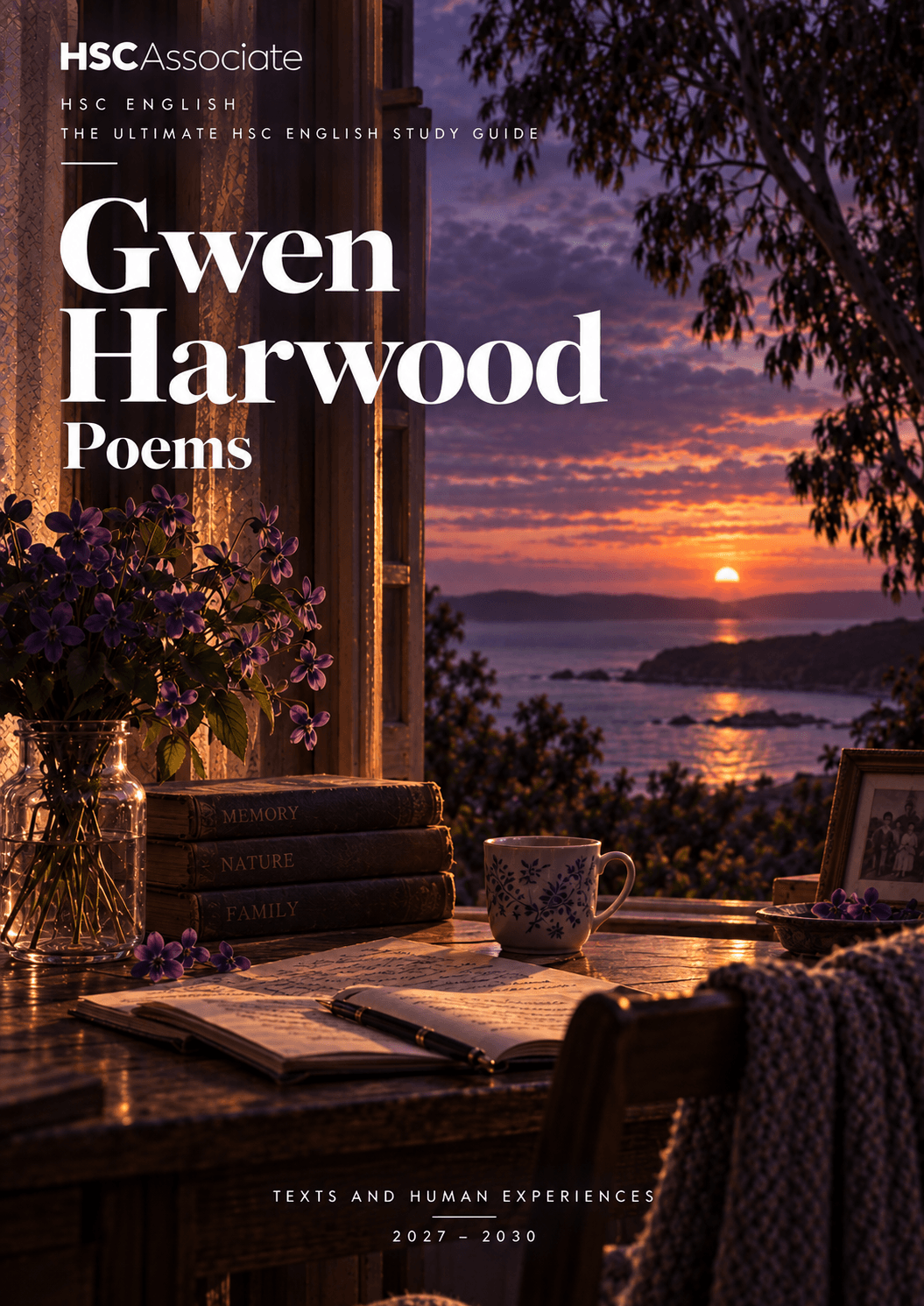
The matching HSCAssociate study guide
Ready to Take Your Gwen Harwood HSC Preparation Further?
Study the prescribed poems together so that your response explains a pattern of ideas and poetic choices rather than treating each poem as an isolated summary.
- Compare ideas across the prescribed poems.
- Explain how poetic form and language shape meaning.
- Select evidence for an argument that can adapt to the question.
Purchase and existing Reader access are handled on the study-guide page.