HSC English · Study article
Henry Lawson Short Stories: HSC Summary, Themes and Analysis
Explore the five prescribed Henry Lawson stories for HSC English: clear summaries, connected themes, human experiences and short-story form.
On this page
Henry Lawson's short stories bring readers close to people working, travelling and raising families in a demanding Australian landscape. His bush is a place of long distances, uncertain income and practical danger. It is also a place where people tell stories, help one another, joke and sometimes fail to connect.
For 2027–2030 HSC English, five stories are studied together. Their different moods matter. The tense night in The Drover's Wife should not be flattened into the same account of mateship as the yarn in Shooting the Moon, or the unruly comedy of The Loaded Dog. Reading the set comparatively helps you explain how Lawson represents human experiences through form and voice.
Henry Lawson Short Stories Summary
The prescribed selection follows a woman protecting her children, strangers attending a union worker's funeral, travelling mates exchanging yarns, and gold seekers fleeing an accidental threat. These are not chapters in one plot. Each story offers a distinct encounter with bush life, while recurring concerns—solitude, work, loyalty and uncertainty—allow you to connect them.
Lawson's significance for Texts and human experiences lies in the way ordinary actions reveal competing feelings. His characters may be resourceful without feeling secure, sociable without being intimate, or funny while facing loss. The short-story form lets one incident or conversation carry those tensions without forcing a tidy lesson.
Summary of the Five Prescribed Stories
The Drover's Wife
While her husband is away droving, a woman lives with her four children in an isolated bush home. When a snake disappears beneath the house, she moves the children to the kitchen and keeps watch through the night with her dog, Alligator. As she waits, the narration recalls earlier dangers and losses, including drought, a bushfire and the death of a child. The immediate threat brings into focus the long, largely unseen work of keeping the family safe. Her endurance is formidable, but Lawson does not present isolation as a reward for strength.
The Union Buries Its Dead
A young union labourer drowns while trying to move horses across a billabong. Almost a stranger in town, he is given a funeral because his union papers identify him as a member. The narrator joins a small procession whose drinking, jokes and awkward gestures sit uneasily beside its respect for the dead. The group learns little about the man it buries. Lawson's irony tests what solidarity can mean when a community honours someone it never really knew.
Shooting the Moon
At a bush camp, Jack Mitchell tells his travelling companion how he and another man once tried to leave a pub without paying because they lacked money. Their attempted escape goes wrong when the landlord catches them, but he responds with food, shelter and money for the road. Mitchell's lively account of the mishap ends with the quiet disclosure that his travelling mate later died. The story's movement from comic yarn to sudden loss gives their long friendship a weight the jokes initially conceal.
Our Pipes
After a punishing day on the track, Mitchell and the narrator camp, eat and smoke. Their conversation prompts Mitchell to remember taking up pipe smoking as a boy, his mother's efforts to stop him, and the private bond he later shared with his father over a pipe. A casual exchange becomes a memory of parents who are now dead. The story finds tenderness in an ordinary habit, while the exhausted bodies and sparse camp keep the men's material hardship in view.
The Loaded Dog
Dave Regan, Jim Bently and Andy Page are gold seekers who prepare a large explosive cartridge to catch fish. Their retriever, Tommy, picks it up and follows the men as its fuse burns. The danger spreads from the claim to a nearby shanty before another dog takes the cartridge and it explodes. Lawson builds comedy through the gap between Tommy's playful intentions and the panic he causes. The men survive, but their clever plan has become a lesson in how quickly human control can fail.
Major Themes in Henry Lawson's Short Stories
Isolation and loneliness
The drover's wife is physically remote and must face the snake without her husband. In The Union Buries Its Dead, people gather around a coffin yet remain strangers to the deceased and often to one another. Our Pipes offers a quieter version: companionship at camp brings Mitchell's absent parents into mind. Lawson makes loneliness possible both far from others and in the middle of a crowd.
Resilience and survival
The wife's night watch is one task among years of practical labour. Mitchell and his companion in Our Pipes first need water, food and a place to sleep after a hard walk. Such actions show resilience as sustained work, not effortless toughness. Even The Loaded Dog turns quick reactions into survival, though its comic confusion questions how much the men truly command their situation.
Mateship and solidarity
Mitchell and the narrator share food, talk and memories in Our Pipes. His account in Shooting the Moon grows from an awkward escape into a ten-year friendship and recalls a landlord's unexpected generosity. The funeral in The Union Buries Its Dead shows a more limited form of solidarity: membership brings people to the burial, but it cannot supply personal knowledge of the dead man. Lawson asks what people actually do for one another, beyond claiming a common identity.
Gender roles and expectations
The Drover's Wife centres the labour and danger borne by a woman while her husband works away. Her vigilance, care and memories complicate any picture of the bush as an exclusively male adventure. Set beside the male travelling circles of Shooting the Moon and Our Pipes, her story widens whose experience counts in an account of Australian life.
Poverty and hardship
The drover's family's losses after drought, the tired swagmen in Our Pipes, and Mitchell's inability to pay the publican in Shooting the Moon make money and work visible pressures. The hopeful gold search in The Loaded Dog has its own labour and uncertainty. These material details keep Lawson's characters from becoming symbols of toughness detached from the conditions they face.
Humour in adversity
Mitchell turns embarrassment into an entertaining escape story; Tommy's innocent retrieving turns danger into farce. Even the funeral narrator notices absurd behaviour amid grief. Humour offers company and perspective, but it does not erase the unpaid bill, the live fuse or the dead stranger. Its changing effect across the stories is more useful than calling every scene simply comic.
Australian identity and belonging
Lawson's bush settings, travelling workers, colloquial speech and local routines help make an Australian world on the page. Yet he resists an uncomplicated national legend. The wife's isolation, the funeral's incomplete fellowship and Mitchell's private grief sit beside loyalty and generosity. Belonging emerges through particular relationships and acts, not through a guarantee that everyone in the bush feels at home.
Human Experiences and Paradoxes
The drover's wife's isolation demands resourcefulness, but her resourcefulness does not make that isolation desirable. In Shooting the Moon, having no money leads Mitchell into a friendship and reveals the landlord's kindness. The hardship is real even though the story becomes funny. These tensions give you a stronger reading than treating resilience and mateship as automatic virtues.
The Union Buries Its Dead gives the clearest example of community alongside emotional distance: union membership secures a funeral, while the mourners know almost nothing about the man. Our Pipes reverses the scale. A small conversation between two men opens onto intimate memories of family loss. The Loaded Dog turns shared danger into collective comic action, although the crisis begins in the men's own plan. Across the set, Lawson shows that human responses can be generous, absurd, guarded and vulnerable at once.
Literary Form and Authorial Purpose
Lawson's compact stories often concentrate on a night, a funeral, a campfire conversation or one escalating mishap. This focus lets a single event reveal a larger life without narrating every year of it. The Drover's Wife moves from the snake watch into remembered ordeals. Our Pipes moves from the present camp to Mitchell's childhood. In Shooting the Moon, a story told aloud changes meaning at its abrupt ending.
His Australian realism depends on concrete work and place: a slab house, a dusty road, tired legs, a mining shaft. Vernacular language gives Mitchell's yarns their social texture and timing. Narrative perspective also matters. The funeral's first-person narrator observes and judges the procession but cannot recover the stranger's inner life; Mitchell tells his own past with comic control until grief briefly breaks through. In The Loaded Dog, an amused narrator lets readers see the distance between the dog's play and the men's fear.
Irony and humour challenge romantic pictures of the bush as a place of endless heroic freedom. Lawson can admire competence and kindness while showing exhaustion, foolishness and loss. Avoid assigning one technique to the whole set: explain how each story's voice, structure and ending shape its particular experience.
Henry Lawson and HSC Texts and Human Experiences
For the 2027–2030 HSC prescriptions, NESA places The Penguin Henry Lawson Short Stories under Texts and human experiences for both English Standard and English Advanced. The prescribed selection comprises all five stories summarised above. Older resources may discuss Lawson under Standard Module A; that label belongs to an earlier prescription, so use the current focus-area name when preparing for HSC 2027 and beyond.
In this focus area, ask how texts represent experiences and the sometimes conflicting responses they prompt. Lawson gives you specific ways to do that: compare the wife's practical watch with the men's wandering companionship, or the funeral's public ritual with the private remembrance in Our Pipes. Then connect the difference to narrative voice, setting, irony or short-story structure. Read every prescribed story closely and check your own evidence against the text.
HSCAssociate Platform · Writing practice
Preparing Your Henry Lawson HSC Essay?
Don't just memorise your analysis. Put it into practice with HSCAssociate.
Essay Marker
Submit HSC English essays and receive detailed feedback to improve your response.
English Essay Builder
Develop your thesis, structure your arguments and prepare for unfamiliar HSC questions.
Get the Complete Henry Lawson Short Stories HSC Study Guide
This overview maps the five stories and their connections. For closer work on form, context, comparative arguments and evidence-led revision, explore the matching HSCAssociate guide. Its Library page shows the current purchase option or your existing Reader access.
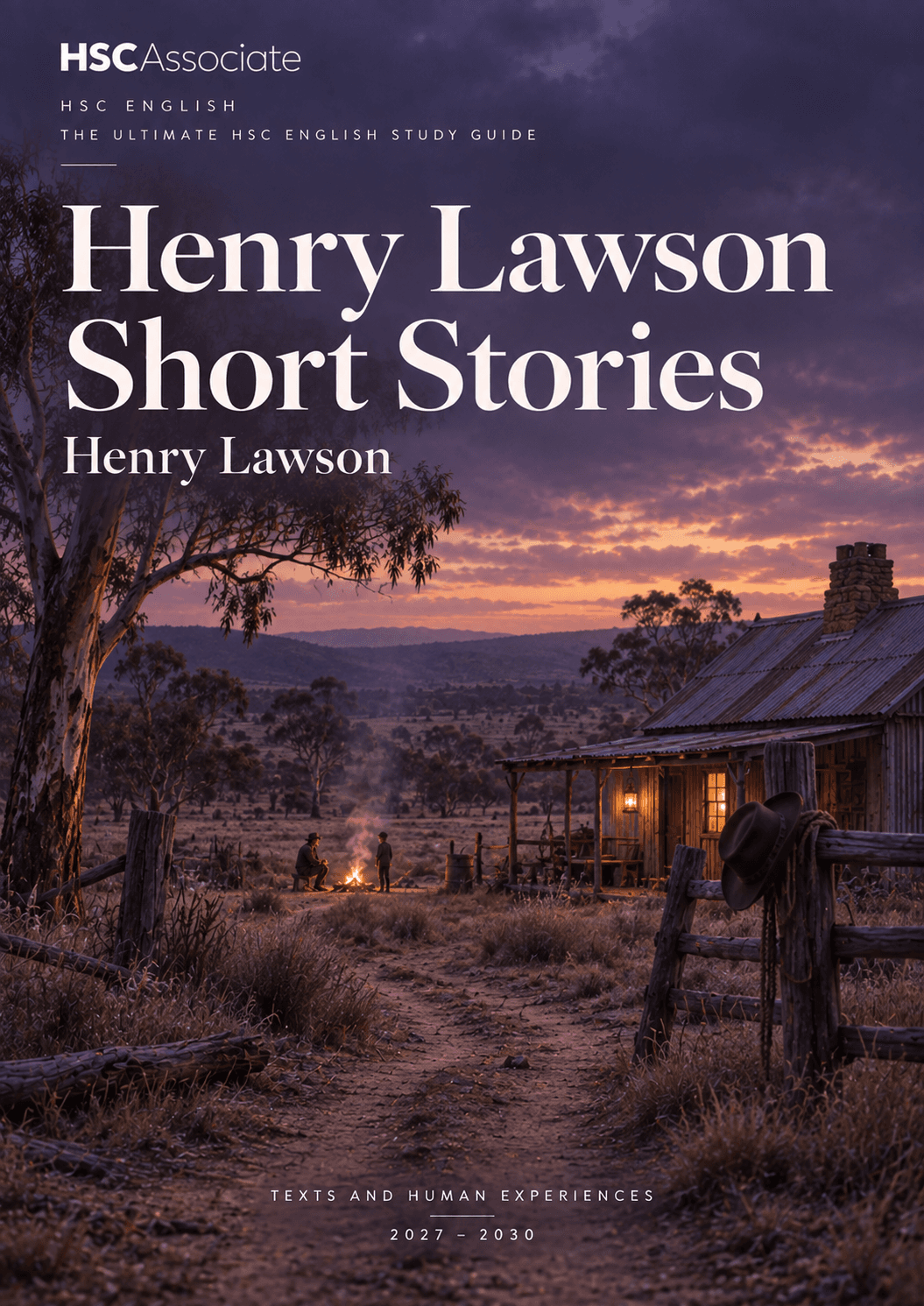
The matching HSCAssociate study guide
Ready to Take Your Henry Lawson HSC Preparation Further?
Read the five prescribed stories as a set and develop a response that connects their ideas without losing the detail of each story.
- Compare ideas across the five stories.
- Analyse how short-story form and context shape meaning.
- Build a thesis supported by evidence from the relevant stories.
Purchase and existing Reader access are handled on the study-guide page.