HSC English · Study article
Love Poems and Death Threats HSC Analysis: Summary, Themes and Poems (2027)
A source-checked guide to Samuel Wagan Watson's seven prescribed poems, their human experiences, and evidence-led HSC comparison.
On this page
Love Poems and Death Threats: the direct answer
Samuel Wagan Watson's Love Poems and Death Threats brings intimate feeling into contact with contemporary Australian politics. The collection's publisher describes poems concerned with love, cultural resilience, materialism and the damage caused by development. For HSC English, the useful question is how a particular poem makes a human experience felt through its language and form, rather than which broad theme can be attached to every selection.
The 2027–2030 NESA prescriptions place the 2014 University of Queensland Press edition (ISBN 9780702253270) in Texts and human experiences for both English Standard and English Advanced. NESA prescribes the seven selections below. The analysis draws on published excerpts, criticism and accessible readings. Check wording and lineation against your prescribed copy before quoting in an essay.
The seven prescribed poems: summaries and analysis
The Remedy of Butterflies
An Into English student book gives this poem its own study section. Its public contents connect it with dehumanisation, modern life and nature as a possible response to alienation in urban environments. This frames a distinct human experience: the pressures of city life can make people feel detached, while attention to living things may challenge that detachment.
The title sharpens that reading. A “remedy” implies harm that needs an answer; “butterflies” names small, vulnerable forms of life rather than an overwhelming force. Placing them together invites a question about whether renewed attention to nature can change how someone experiences an alienating environment. It does not suggest that a brief natural encounter erases the causes of dehumanisation. Essay argument: Watson's title opens a tension between urban estrangement and the possibility of reconnection through nature. Develop that argument with language you can verify in the prescribed poem.
Finn
“Finn” takes the Brisbane River during the 2010–11 Queensland floods as a way to reconsider familiarity with a place. In a peer-reviewed study of Indigenous hydropoetics, John Charles Ryan discusses the poem's movement from childhood association with the river to its frightening force during flooding. Ryan also traces the significance of the river's different names. His discussion includes short textual extracts; this account does not claim a reading of every line of the poem.
The central human experience is a change in how people relate to a river they thought they knew. The poem can be read as a tension between intimacy with place and the limits of human control. The shifts in river imagery and naming matter because they represent a changing relationship, rather than merely decorating a flood narrative. Essay argument: Watson makes the river's power unsettle a simple idea of place as human possession. Compare this carefully with the road in “El Diablo Highway”: both involve place, but one centres a river in crisis and the other a route shaped by imposed infrastructure.
Let's Talk!
Ruth Barratt-Peacock's open access scholarly reading quotes a substantial passage from “Let's Talk!” and reads it as Watson's call to keep speaking across the limits of language. The passage names a treaty, genocide and reconciliation. Its repeated imperative, “let's talk”, is addressed as a collective demand for sustained exchange rather than evidence that an equal conversation has already happened.
The repetition gathers urgency as the poem moves from political proposals to the exhaustion and care involved in standing together. Violent imagery and the image of voices settling into embers prevent the appeal to talk from sounding easy or sentimental. Barratt-Peacock argues that the poem offers no final resolution: dialogue matters precisely because history and unequal power cannot be made to vanish by a single conversation. Essay argument: Watson turns repeated speech into an ethical practice, while keeping the harms that make such speech necessary in view. This gives a sharper comparison with “Blacktracker... Blackwriter... Blacksubject”, where control over words and who gets to speak are also at stake.
El Diablo Highway
In Sydney Review of Books, Evelyn Araluen identifies “El Diablo Highway” as a seven-stanza poem and discusses its opening contrast between the highway and older songlines. The review reads the highway as an imposed route across land whose previous relationships and memories have not disappeared. The evidence supports a poem about place, colonial transformation and the experience of moving through contested Country.
The opening contrast between highway and songline does more than oppose two travel routes. It asks whose account of place becomes visible and whose is obscured when new infrastructure is laid over existing connections. The seven-stanza movement may extend or complicate that opening, but the full trajectory still needs checking against the prescribed book. Essay argument: Watson uses a road's apparent promise of movement to expose the limits placed on belonging and historical memory. Pair this with “Finn” when discussing how built and natural spaces affect the people who move through them; retain each poem's different situation.
Blacktracker... Blackwriter... Blacksubject
This prose poem turns three racialised labels into a moving account of authorship and constraint. A scholarly discussion in TEXT explains how its language questions the coloniser's power to define, write about and “edit” Aboriginal subjects. An ABC interview with Watson also discusses the poem's concern with writing and colonial power.
The repeated “black” prefixes do two things at once: they mark how the speaker is categorised and allow the speaker to name different roles for himself. The prose-poem form keeps those roles in close contact rather than resolving them into a simple account of artistic freedom. The human experience here is the pressure of making art within a language and publishing culture shaped by colonial authority. Essay argument: Writing offers Watson agency, yet the poem refuses to pretend that holding the pen removes the unequal power surrounding it. Its treatment of language can be compared with “El Diablo Highway”, where a route across Country similarly carries a history of attempted overwriting.
End of Days
A contemporary review published by the Grattan Institute identifies “End of Days” as a dark satire of Australia's mining and consumer-debt boom. The reviewer reads the poem's contrast between the Dreamtime and the Australian Dream as a question about what prosperity has cost. A third-party public reading places financial news beside an imagined catastrophe and a bank warning over a small credit-card debt.
This juxtaposition makes a person's minor debt feel oddly urgent beside the larger cost of extracting resources from Country. The apocalyptic frame turns economic confidence into a source of unease: what is called a boom can also signal loss. Essay argument: the poem's satire challenges the measures of value behind the Australian Dream and asks what those measures leave out.
Addendum
In an ABC Radio National interview and reading, Watson performs “Addendum” and the interviewer identifies it as the collection's final poem. It begins with an epigraph from W. H. Auden's “September 1, 1939” about love and death. Watson then turns to a remembered picture of someone whose sweetness persists alongside images of grudges, ghosts and butterflies wanting more time. The poem ends by bringing the collection's opposed title words together.
The human experience is the afterlife of a relationship: affection remains, but hurt and awareness of time remain with it. The allusion sets up a stark choice between love and death; Watson's compressed sequence of images makes that choice feel less simple. The return to the book's title gives the short ending a double force, holding tenderness and threat in the same memory. In the interview Watson relates the poem to the lasting scars of a breakup. Essay argument: The closing lyric refuses to separate love from vulnerability or resentment, so it revises any easy promise of emotional resolution.
Themes across the collection
Comparisons work best when the same image or concern does different work in each poem. Use the table to build a line of argument, then return to the prescribed text for your own quotations.
| Poems | Human experience | Meaningful comparison | What to examine |
|---|---|---|---|
| Finn / El Diablo Highway | Living with place and its history | A flooding river unsettles familiarity; a highway exposes an imposed route. | Changes in river naming versus the opening highway/songline contrast. |
| Let's Talk! / Blacktracker... Blackwriter... Blacksubject | Speaking under unequal power | One insists on continuing dialogue; the other probes who has the authority to write about whom. | Repeated imperatives versus repeated racialised labels. |
| End of Days / El Diablo Highway | The cost of development | Economic satire and the road's spatial history reveal different forms of damage to Country. | Mining and debt vocabulary versus highway/songline imagery. |
| The Remedy of Butterflies / Addendum | Attention to life's fragility | The Remedy's title suggests nature as a response to urban estrangement; Addendum's butterfly image expresses a wish for more time after love. | Compare what butterflies mean in each poem's different context. |
Poetic form and the making of meaning
Form becomes useful in an essay when it explains a particular effect. The title “The Remedy of Butterflies” pairs the idea of healing with fragile natural life, framing a question about modern urban experience. The repeated collective imperative in “Let's Talk!” keeps an ethical demand active across images of violence and exhaustion. “End of Days” brings apocalyptic and economic frames into contact, while the brief “Addendum” concentrates an allusion and contrasting images into the collection's last words.
In “Blacktracker... Blackwriter... Blacksubject”, the scholarly evidence identifies a prose poem that repeats racialised terms, keeping artistic agency and colonial constraint in contact. The seven-stanza “El Diablo Highway” opens by opposing highway and songline, while “Finn” changes the river's description and names. These are different formal choices, so name the exact choice before explaining its effect. Our HSC English literary techniques guide shows how to turn a technique into an argument. For another 2027 poetry text, see the published Gwen Harwood HSC analysis.
How to write a Band 6 response
An adaptable thesis is: Watson represents human experience as a negotiation with forces that shape place, language and value; his poetic choices show people responding to those forces without making resistance simple. Adapt its key terms to the actual question and the poems you can support. Do not present it as a memorised answer for all seven.
Three possible lines of argument are:
- Place is relational, not merely a setting. Compare the river's altered meaning in “Finn” with the competing histories of travel in “El Diablo Highway”.
- Language can give voice while carrying unequal power. Compare the contested authorship of “Blacktracker... Blackwriter... Blacksubject” with the collective call to keep speaking in “Let's Talk!”.
- Ordinary measures may conceal larger costs. Set the mining and credit-card satire of “End of Days” against the road's imposed route through Country in “El Diablo Highway”.
In “El Diablo Highway”, Watson's opening distinction between the highway and older songlines makes travel a question of historical power. The road suggests an efficient route, yet Araluen's reading shows how its construction overlays prior relationships to Country without erasing them. The contrast therefore places movement beside dispossession: a traveller can use the road while the place still holds meanings the road cannot express. Watson represents belonging as an experience shaped by competing histories, rather than a simple feeling of being at home.
For your own response, read the question's key terms, choose two or three poems whose verified evidence develops a connected answer, and make each paragraph show what the language does. Revise the thesis if the evidence complicates it. The prescribed text, not a sample paragraph, must supply your quotations.
Love Poems and Death Threats HSC FAQs
What is Love Poems and Death Threats about?
The collection brings love, anger and social criticism into contact. Its poems examine relationships and contemporary Australia, including the effects of colonial history and development.
Which seven poems are prescribed for the 2027–2030 HSC?
The Remedy of Butterflies; Finn; Let's Talk!; El Diablo Highway; Blacktracker... Blackwriter... Blacksubject; End of Days; and Addendum.
What themes can I compare across the prescribed poems?
Compare place and Country, the power of language, economic priorities, and the different meanings of butterflies in The Remedy of Butterflies' title and Addendum. Show how each poem develops the idea differently.
How does Samuel Wagan Watson represent human experiences?
He makes particular experiences vivid through changing river imagery, the contrast between road and songline, repeated calls to talk, economic satire, and images of brief life.
How should I structure a strong HSC response?
Answer the question with one adaptable thesis, group relevant poems by an idea, and explain how precise language or form in each poem makes that idea meaningful.
Final takeaways
Know the exact seven prescribed selections, read the UQP edition, and build comparisons from specific moments. A repeated image does not carry a fixed meaning: the title “The Remedy of Butterflies” invites a reading about reconnecting with nature, while a butterfly in “Addendum” carries a wish for more time. Compare the different contexts, then use accurate quotations from your own copy to explain why.
HSCAssociate Platform
HSCAssociate Platform · Writing practice
Preparing Your Samuel Wagan Watson HSC Essay?
Don't just memorise your analysis. Put it into practice with HSCAssociate.
Essay Marker
Submit HSC English essays and receive detailed feedback to improve your response.
English Essay Builder
Develop your thesis, structure your arguments and prepare for unfamiliar HSC questions.
Love Poems and Death Threats HSC Study Guide
The matching HSCAssociate Library guide is a separate resource for comparing the prescribed poems and practising evidence-led responses. Check its Library page for current access and purchase options.
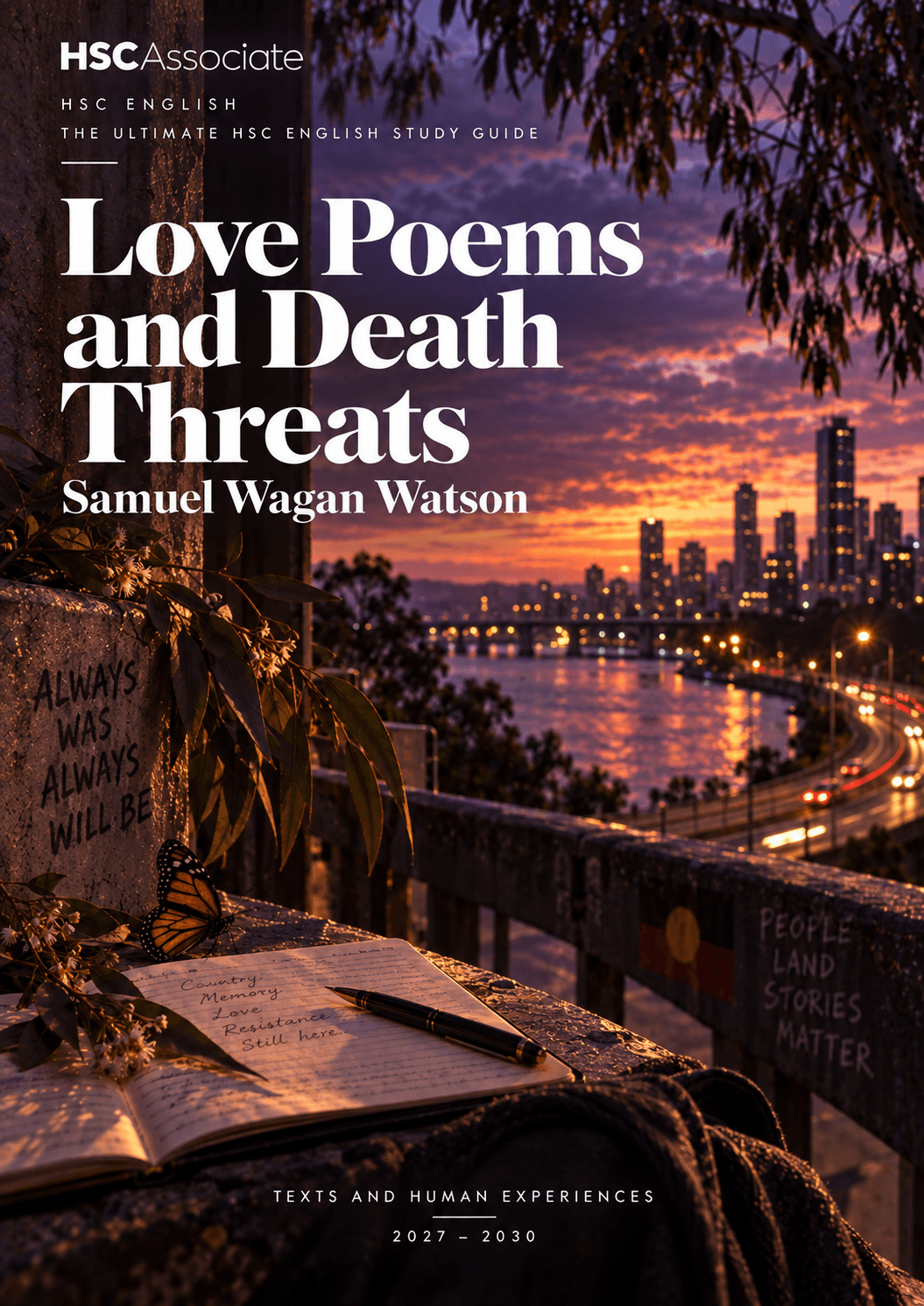
The matching HSCAssociate study guide
Continue Your Love Poems and Death Threats Study
Develop a connected understanding of the seven prescribed poems and the ways poetic language and form contribute to meaning.
- Compare the poems through a clear line of argument.
- Analyse voice, language and poetic form in context.
- Practise explaining quotations rather than inserting them without analysis.
Purchase and existing Reader access are handled on the study-guide page.