HSC English · Study article
Away HSC Analysis: Summary, Themes, Characters and Techniques (2027)
A close guide to Michael Gow's Away: its three families, five-act journey, dramatic form and human experiences for the 2027–2030 HSC.
On this page
Away by Michael Gow: an introduction
Away is Michael Gow's Australian play about three families leaving home for Christmas holidays in the summer of 1967–68. One family lives with a son's terminal illness; another grieves a son killed in Vietnam; a third struggles with a mother's fear of losing the security she has worked to gain. Their journeys intersect after a storm. The play asks what people protect, conceal and finally recognise when ordinary family rituals meet suffering.
Gow makes those experiences visible through drama, not simply through a story told about them. An audience hears awkward exchanges, sees a storm overtake a holiday camp, watches an amateur performance and then witnesses a nearly wordless sequence of reconciliation. Comedy and theatrical fantasy sit beside illness and grief. That movement matters more than a claim that everyone is healed.
For the 2027–2030 HSC, NESA prescribes Away for Texts and human experiences in both English Standard and English Advanced. The specified text is Currency Press, 1988, ISBN 9780868192116. The current NESA prescription list supplies those details; Currency Press confirms the ISBN.
Away plot summary: the five-act journey
Act I: a school play exposes family tensions
The play opens as a school production of Shakespeare's A Midsummer Night's Dream ends. Tom and Meg's involvement in the performance brings the young people together, while their parents reveal different attitudes to them. Tom's British migrant parents, Harry and Vic, take pride in him. Meg's mother Gwen objects to her daughter's interest in a boy she judges socially unsuitable; Jim tries to soften the tension. Coral, married to headmaster Roy, is distressed by the young performers. The families prepare for separate summer holidays, and the audience begins to see that ordinary talk about travel and possessions conceals larger anxieties.
Act II: departures expose private pressures
As the families prepare to leave Sydney, Harry and Vic privately face the reality of Tom's serious illness. Gwen's attention to presents, arrangements and status strains her relationship with Meg and exposes Jim's difficulty in challenging her. Coral and Roy's exchanges show that their planned resort holiday cannot remove Coral's grief for their son, who died in the Vietnam War. Roy's demand that she return to expected social behaviour deepens their separation.
Act III: separate holidays and the storm
Harry, Vic and Tom choose a modest camping holiday. Jim, Gwen and Meg travel with a well-equipped caravan, while Coral and Roy stay at a resort. Coral's encounter with the younger Rick shows how grief unsettles her grasp on the present; it should not be reduced to a simple romance.
The storm breaks into these parallel holiday scenes. Fairies associated with the play's Shakespearean world participate in its theatrical staging. The storm damages Gwen's carefully guarded possessions and helps redirect the families towards the same stretch of coast. It is an event within the plot and a visible break in its earlier order.
Act IV: encounters and a play within the play
At the beach, Vic leads Gwen away after Gwen's outburst, while Harry privately tells Jim that Tom has leukaemia. Gwen also learns of the family's situation. These separate conversations change the terms of the adults' earlier judgments: a family Gwen has judged by its possessions is facing a much more serious fear. Tom, meanwhile, tells Meg that he knows he is dying. Their conversation gives him an independent perspective rather than making him only the object of parental concern. Meg's response also shows that compassion does not require surrendering her own boundaries.
Tom and Coral perform The Stranger on the Shore at the campers' amateur night. This small play within Gow's play gives Coral a way to move again and lets Tom communicate through a role what ordinary conversation has struggled to hold. The audience watches other characters watch them. That double audience makes performance itself part of the argument about understanding.
Act V: gestures of reconciliation and an open future
The final act begins with a largely silent sequence: Jim gives Gwen a gift and they embrace; Coral offers Roy shells and they reconnect. Gow's choice to rely on gesture rather than explanatory speeches suggests a tentative return to one another. The scene does not reverse their pasts, guarantee lasting harmony or alter Tom's prognosis.
The published play returns to the schoolyard. Miss Latrobe introduces King Lear, and Tom reads the opening of Lear's speech about relinquishing power and approaching death. A young person speaking the words of an ageing king brings mortality into the ordinary start of a new school year. The ending leaves Tom's future uncertain. A later Gow revision for a production gives the reading to Meg; students analysing the prescribed Currency Press text should keep that variation separate from the printed ending.
Away character analysis
The characters become most useful in essays when their choices are read in relationship. Gow repeatedly places one family's outward habits beside another family's hidden pain.
Tom
Tom is Harry and Vic's son, Meg's schoolmate and Coral's fellow performer. His central conflict is living as a young person while knowing that his life may be short. His parents' protective cheerfulness and Harry's private disclosure show how illness changes a whole family; Tom's conversation with Meg prevents the audience from assuming that he is unaware or passive. In The Stranger on the Shore, his performance helps Coral articulate movement after grief, while his final reading from King Lear joins youth to mortality. An essay can argue that Gow uses Tom's changing theatrical roles to make vulnerability an active source of understanding, without treating him as a magical cure for others.
Meg
Meg is Gwen and Jim's daughter and Tom's friend. Gwen's disapproval of Tom turns Meg's growing independence into a family conflict. Meg challenges the certainty of her family's Christmas rituals and later responds to Tom's frankness with empathy while retaining her own agency. Their dialogue allows two young people to speak directly about desire, fear and death, in contrast to the adults' concealment. Meg is useful in an essay about the tension between care and control: she shows that listening to another person does not mean agreeing to every request.
Gwen
Gwen is Meg's mother and Jim's wife. She prizes a secure, respectable family holiday, and her judgments about Tom's family reveal how class anxiety can harden into cruelty. Jim's recollection of her earlier poverty complicates a flat reading of her as merely materialistic: possessions have become protection against remembered insecurity. The storm's destruction of the caravan's order and Harry and Vic's disclosure challenge that defence. Her later gesture of acceptance with Jim suggests change, but not the erasure of her history. An essay can trace how Gow moves Gwen from controlling dialogue and objects towards a nearly silent recognition of other people's vulnerability.
Jim
Jim is Gwen's husband and Meg's father. He often tries to make others comfortable, yet his gentle manner can leave Gwen's treatment of Meg unchallenged. His account of Gwen's deprived youth gives the audience a reason to understand her fear without excusing its effects. Meeting Harry and Vic and learning about Tom shifts the family's priorities; the final gift and embrace give Jim a physical way to reach Gwen. Analyse the contrast between his accommodating speech and this later stage action when arguing that care needs more than passive goodwill.
Coral
Coral is Roy's wife and a mother grieving their son killed in Vietnam. At the school play she responds painfully to the sight of young performers; on holiday she struggles to rejoin social life on Roy's terms. Her encounters with Rick and then Tom reveal a search for connection shaped by loss, not a neat replacement for her son. Her performance with Tom lets the audience watch her act out a movement from being unable to walk towards taking steps. The later exchange of shells with Roy leaves grief present while making contact possible. An essay can show how Gow uses metatheatre and gesture to represent recovery as movement, not forgetting.
Roy
Roy is Coral's husband and the school headmaster. He grieves their son too, but tries to impose order and worries about Coral's public behaviour. Their exchanges expose a contradiction: he wants closeness while speaking in ways that isolate her. The resort and his professional status cannot manage private loss. In the final mime, Roy's response to Coral's shells offers a different form of communication. An essay can compare his early controlling dialogue with the final wordless scene to examine the limits of authority in the face of grief.
Harry
Harry is Tom's father and Vic's husband. He tries to give his son a good holiday while privately knowing that Tom is terminally ill. His disclosure to Jim makes the audience reconsider earlier talk about the family's modest tent and supposed social standing. Harry's concern is not simply optimism: he must protect the time the family has without pretending it is unlimited. His role supports an argument about dramatic irony, because the adults and audience learn different parts of Tom's situation at different times.
Vic
Vic is Tom's mother and Harry's partner. Her warmth, delight in the Australian coast and care for Tom coexist with knowledge of his illness. She does not measure the holiday by the equipment the family owns. Her conversations with Gwen place generosity and anxiety beside Gwen's suspicion and status consciousness; neither woman's conduct is explained by class alone. Vic gives an essay a way to discuss how ordinary pleasures can be meaningful when a family lives with uncertainty.
Starting point
Developed argument
Major themes in Away
Grief and mortality
Coral and Roy's son has already died in Vietnam; Tom is alive but gravely ill. This contrast prevents grief from becoming one uniform experience. Coral struggles to re-enter a world that continues around her, while Roy tries to organise and contain their pain. Harry and Vic live with anticipatory grief as they make a holiday for Tom. Tom's own knowledge of his condition complicates their attempt to shield him. In an essay, compare these responses and explain how the audience's knowledge changes across scenes.
Family relationships
The families love one another, yet love does not guarantee understanding. Gwen sees Meg's independence as a threat to the security she has built. Roy wants Coral to function socially but fails to hear what she needs. Harry and Vic protect Tom while he already understands more than they realise. Gow lets these tensions emerge through interrupted conversations, awkward social encounters and contrasting gestures. The play's movement towards contact therefore has weight because relationships have first been shown as difficult work.
Social class and materialism
The tent, caravan and resort establish different holiday styles before the audience knows each family's private situation. Gwen reads the material difference between her family and Tom's as a social judgment. Jim's memory of her earlier deprivation gives that judgment a history, while Harry and Vic's news exposes its inadequacy. The play criticises the assumption that comfort measures worth; it does not claim that poverty itself is virtuous or that Gwen's fear came from nowhere.
Change and personal transformation
The characters cannot simply return to their original arrangements once the storm and later disclosures bring them together. Gwen's attitude shifts, Coral begins to move towards Roy, and Jim acts on his affection. Tom's illness, however, is not transformed away. Gow's dramatic structure makes change partial and relational: people may alter how they speak, listen or respond even when the cause of suffering remains.
Reconciliation and healing
The final mime gives reconciliation a visible form. Jim's gift and Coral's shells are small, specific offers that invite responses; they are stronger than a speech declaring everyone healed. Coral and Roy can reconnect without recovering their son. Gwen and Jim can embrace without the audience knowing the future of their marriage. This distinction helps an essay avoid a sentimental conclusion.
Nature and renewal
The coast lets the families meet outside the social arrangements that organised their lives at school and home. The storm has disruptive force, especially for Gwen, while the beach offers space for Tom and Coral's amateur performance. Renewal is a defensible interpretation of this setting, provided it is tied to what characters do there. Nature is not a medical treatment or a guarantee that grief ends. Gow's staging makes weather and place visible agents in the drama; the production's particular lighting or sound design should be identified only when analysing that production.
Individual and shared human experiences
The three families share a holiday season and the experience of change, but their circumstances are not interchangeable. Tom's impending death differs from Coral's bereavement; Gwen's fear of poverty differs from Harry and Vic's fear of losing a child. The storm and campsite performance bring these private experiences into a shared space. Gow asks audiences to notice both the connection and the difference rather than turning all eight characters into examples of one lesson.
Dramatic techniques and theatrical form
| Dramatic choice | Moment in the play | How it shapes meaning |
|---|---|---|
| Juxtaposition and setting | Tent, caravan and resort holidays | Places material differences beside private suffering, making quick class judgments unstable. |
| Dialogue and characterisation | The adults' talk after the school play; Coral and Roy's exchanges | Everyday speech exposes status anxiety, avoidance and incompatible ways of grieving. |
| Dramatic irony and disclosure | Harry tells Jim of Tom's illness; Tom later speaks to Meg | The audience revises its view of who knows what, and sees the limits of protective silence. |
| Staged storm and spectacle | Fairies interrupt the holiday world | A physical disruption makes the collapse of a familiar social order visible to an audience. |
| Metatheatre | The school Dream and The Stranger on the Shore | Characters perform for other characters, making storytelling a route to recognition. |
| Gesture and structure | The silent reconciliation, then the return to school | Actions carry emotional change without claiming that dialogue can explain or resolve every loss. |
Stage directions and theatrical spectacle. The storm and the final wordless sequence turn changes in the families' relationships into stage action. A director decides the scale of scenery, lighting, sound and movement in a particular staging. Analyse what the written play asks an audience to witness, then name a production's choices only when you have actually studied that production. The Australian Plays Transform production resource reproduces short script excerpts and distinguishes them from decisions in its 2017 staging.
Symbolism and dramatic irony. Holiday possessions carry social meanings because characters give them meanings: Gwen's caravan embodies control and security, while Harry and Vic's lean-to tent initially invites class judgment. The storm's damage can symbolise the failure of possessions to protect against loss. Yet the audience must also attend to the real event: characters are forced into new encounters. Gow controls information about Tom so that assumptions about his family's modest holiday and his own awareness are revised in stages.
Plays within the play.A Midsummer Night's Dream is not a decorative opening. Tom and Meg's school performance gathers all three families, provokes Coral's response and introduces a theatrical world in which apparent order can be unsettled. At the campers' amateur night, The Stranger on the Shore lets Tom and Coral communicate indirectly through roles. The double act of watching—characters observing a performance while the audience observes them—shows how a made-up story can expose something difficult to say directly.
Shakespearean intertextuality and structure. The opening Dream and closing King Lear form an explicit frame. The fairies and storm evoke the comic theatre of disruption and reunion, while Lear's opening words bring age, power and mortality back into view. The storm can also recall The Tempest; that is a supported resonance, not a claim that Gow reproduces its plot. The five-act movement from school, through separate holidays and a common beach, back to school makes reconciliation possible without changing the reality of Tom's illness. The ending's Lear passage keeps the play's comic and tragic registers together.
Away and Texts and human experiences
NESA's 2024 English Standard and Advanced syllabuses use Texts and human experiences as the Year 12 focus area, first examined in 2027. The Standard course overview and Advanced course overview confirm that terminology. Use the current focus-area name when planning, even if older resources use “Common Module”.
Away offers a precise way to discuss individual and shared experiences. Coral, Roy, Harry, Vic and Tom each encounter loss or its prospect, yet differ in what they can say. Gwen's conduct shows a contradiction between a wish to protect family and behaviour that damages family trust. Meg's growing independence changes what care can mean between parent and child. The play's layered audiences also ask what storytelling does: watching a staged story can bring an audience close to another person's fear without requiring that person to explain it directly.
In an essay, start with the question's particular idea—perhaps the contradictions in human behaviour or the effect of relationships—then choose a sequence of scenes that tests it. Name the focus area where it clarifies your argument. Repeating syllabus vocabulary without showing how a scene works will add little. For a contrasting text in the same focus area, see our Gwen Harwood poetry analysis or Henry Lawson short stories analysis.
Band 6 essay preparation for Away
An adaptable thesis
Gow's Away shows that suffering can isolate people even within loving families, while shared places and performances can unsettle defensive habits and make limited, meaningful reconciliation possible. Its movement between domestic realism and theatrical fantasy keeps that possibility in tension with mortality rather than offering an easy cure.
This is a starting claim, not a memorised answer. Change its emphasis to match the question and test it against the scenes you choose.
Three distinct essay arguments
- Private fear shapes public behaviour. Set Gwen's judgments beside Jim's account of her earlier poverty, and Roy's public concern beside Coral's grief. Analyse dialogue and the contrast between holiday settings to show why people can hurt those they mean to protect.
- Disclosure changes relationships. Compare Harry's private account of Tom's illness to Jim, Gwen's response after walking with Vic, and Tom's own conversation with Meg. Analyse who is present for each exchange and when the audience learns what Tom knows; care requires listening to the person whose experience adults think they control.
- Performance opens contact while leaving loss intact. Follow the school Dream, Tom and Coral's amateur play, the silent reconciliations and the Lear ending. Explain how metatheatre, gesture and structure create hope without cancelling death or bereavement.
Model analytical paragraph
Question focus: How can shared experiences change people's understanding of others? Gow presents change as an encounter with another family's hidden vulnerability, rather than as a moral lesson delivered by the storm. Early conversations about the families' different holidays let Gwen measure Harry and Vic's modest tent against her well-equipped caravan; the dialogue makes social rank seem more urgent than the people beneath it. At the beach, Gwen's outburst is followed by Vic leading her away and a pause before Harry privately tells Jim that Tom has leukaemia. That separation on stage controls who hears the news and when; the disclosure recasts the earlier contrast between tent and caravan as a contrast between visible possessions and hidden fear. Gwen's later wordless reconciliation with Jim is therefore more persuasive than a speech announcing a new opinion. Through juxtaposition, silence and gesture, Gow shows how shared experience can loosen defensive judgments while leaving the illness itself unchanged—an important tension in his representation of human experiences.
Adapt your response to the question
For a question about contradictions, foreground Gwen's protective fear and harmful control, or Roy's wish for closeness and isolating language. For relationships, compare two families and show how staging places them in contact. For storytelling, trace the play's performances and ask what a role lets Tom or Coral communicate. For change, separate altered behaviour from circumstances that remain unchanged. In every version, choose evidence that answers the wording and analyse its dramatic effect. Check any quotation against the prescribed edition before using it in an assessment; the paragraph above uses verifiable dramatic moments without reproducing Gow's dialogue. Our guide to HSC English techniques can help you move beyond naming a device.
Away HSC FAQs
What is Away by Michael Gow about?
Away follows three Australian families on separate Christmas holidays in the summer of 1967–68. Tom and his parents face his terminal illness; Coral and Roy grieve their son, killed in Vietnam; and Meg's family struggles with class anxiety and control. A storm brings their paths together, and performance helps them confront loss and change.
What are the main themes in Away?
The play explores grief and mortality, family conflict, social class and materialism, change, reconciliation, and the renewing possibilities of nature and theatre. Each family responds differently, so no single theme supplies a complete explanation of the play.
Who are the main characters in Away?
The central families are Tom with his parents Harry and Vic; Meg with her parents Gwen and Jim; and Coral with her husband Roy. Their relationships connect the play's private experiences of illness, bereavement, parental fear and growing independence.
What does the storm symbolise in Away?
The storm disrupts Gwen's carefully managed holiday and helps bring the families together. Its theatrical spectacle can suggest the collapse of social barriers and the possibility of change, but the storm does not itself cure grief or Tom's illness.
How does Away represent human experiences?
Gow places different families' responses to loss and change side by side. Dialogue, contrasting holiday settings, a staged storm, Shakespearean framing and a play within the play let audiences witness how personal suffering affects relationships and how shared stories can open understanding.
How do you write a Band 6 essay on Away?
Answer the exact question with a flexible thesis, choose precise dramatic moments, and explain how Gow's form shapes an audience's understanding. Connect character relationships to techniques such as juxtaposition, staging and metatheatre; check any quotation against the prescribed Currency Press edition.
Final takeaways
HSCAssociate Platform
HSCAssociate Platform · Writing practice
Preparing Your Away HSC Essay?
Don't just memorise your analysis. Put it into practice with HSCAssociate.
Essay Marker
Submit HSC English essays and receive detailed feedback to improve your response.
English Essay Builder
Develop your thesis, structure your arguments and prepare for unfamiliar HSC questions.
Away HSC Study Guide
The published Away study guide offers structured practice in dramatic form, argument building and selecting evidence for a response. Its Library page shows current purchase and Reader access options. Use the prescribed play itself to verify any quotation or stage direction you plan to include in an essay.
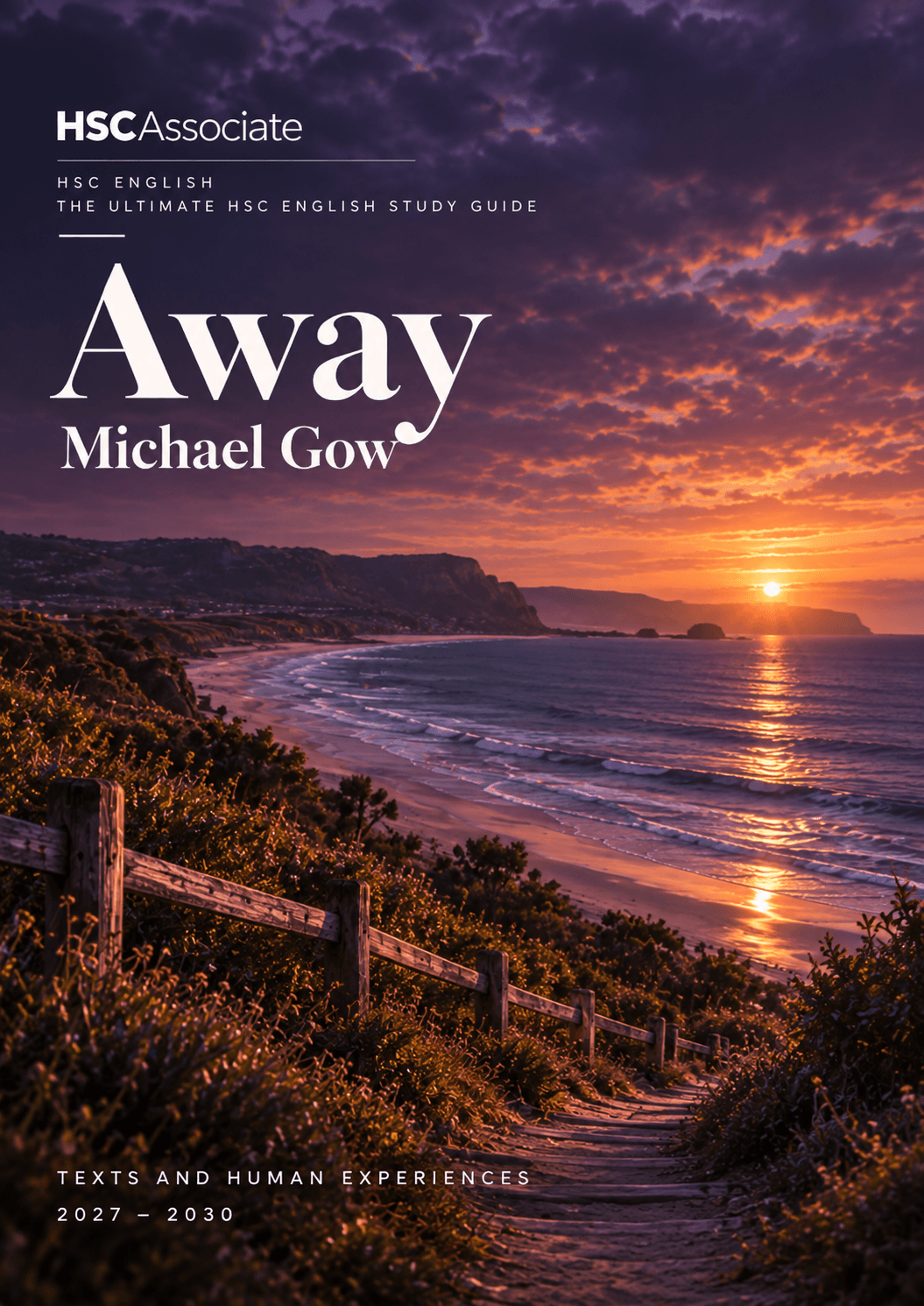
The matching HSCAssociate study guide
Take Your Away HSC Preparation Further
Study how Gow's drama presents family conflict, grief, class and renewal, then turn those observations into a coherent response.
- Trace how dramatic form shapes the audience's understanding.
- Connect the play's concerns to a defensible thesis.
- Choose and explain evidence rather than recounting the plot.
Purchase and existing Reader access are handled on the study-guide page.