HSC English · Study article
Rosemary Dobson: HSC Poetry Summary, Themes and Analysis
Explore Rosemary Dobson's seven prescribed poems for 2027–2030 HSC English, with clear summaries, themes and insights into poetic form.
On this page
Rosemary Dobson Poetry Overview
Rosemary Dobson was an Australian poet whose work can make an ordinary scene feel charged with questions about time, responsibility and the life a person might choose. In the seven poems prescribed for 2027–2030 HSC English, she moves from a girl at a window to a parent walking alone at night, from a child's uncertain future to an imagined sculpture of the self. Her speakers notice particular people and objects, but the questions they raise extend beyond any one life.
The selection is varied in voice and mood. Some poems reflect on growing older or remembering childhood; others are playful, satirical or anxious about the future. Read together, they show how Dobson uses precise situations to explore human experiences without pretending that freedom, care, creativity or knowledge has a simple meaning.
Summary of the Seven Prescribed Poems
Young Girl at a Window
A speaker addresses a young girl poised at a window and imagines the journey ahead of her. The room and the world beyond it become a threshold between the protected present and a future that cannot be avoided. Images of a clock, hills and changing seasons make time feel both strangely suspended and inexorably forward moving. The poem's significance lies in its mixture of invitation and warning: growth promises possibility, but it also involves risk and mortality.
Summer's End
This two-part poem begins as summer crowds leave a beach. The departing holidaymakers become a wave that sweeps towards public transport, while a lonely mermaid remains by the water. In the second part, an autumn picnic awakens the speaker's memory of childhood play; the adult then waits in vain for that earlier child to return. Seasonal change thus becomes personal change. The poem contrasts the bustle of departure with solitude and the pleasure of remembering with the impossibility of recovering a past self.
Cock Crow
The speaker leaves a lit house, hoping briefly to be alone and free of family demands. Yet she walks the same stretch of road three times and turns back. Her sleeping mother and daughter place her between generations, while the cock's repeated crow marks the end of her imagined separation. The poem does not dismiss her need for an independent self. It shows how that need remains entangled with love, obligation and the relationships that give her life its shape.
A Fine Thing
Rather than telling a single story, the poem imagines what it might be like to be three made figures: a scarecrow, a ship's figurehead and a snowman. Each has an appealing way of inhabiting the world, from mischievous ease to far-looking stillness. The snowman's apparent freedom from trouble also comes with loneliness. Dobson's playful shifts of perspective invite the reader to test the attraction and the limits of lives that seem simpler than our own.
Child of Our Time
A parent addresses a child who is already moving beyond her control. She recalls carrying the child before birth, then recognises a future whose possibilities she cannot foresee. Her imagination reaches towards space travel and towards the dangers of war. The poem broadens private parental fear into a concern shared by earlier generations of women, while insisting that this child's world brings new and unsettling risks. Love is present here as hope, vulnerability and the act of letting another person go.
Piltdown Man
Dobson gives a comic voice to the assembled fossil once presented as a prehistoric human. The figure boasts of its museum status and the applause of experts before scientific tests expose it as a fabrication. The poem's jaunty performance makes a serious point about the human appetite for a convincing discovery. Its target is credulity and prestige, rather than science itself: scientific methods finally challenge the false story that people had welcomed.
Every Man His Own Sculptor
A speaker imagines shaping the face and hands through the experiences and feelings of a lifetime. Despair, wonder and calm become tools in this self-portrait; the hands reach out to discover, give and take. The sculpture is therefore unfinished in spirit even as the speaker describes its features. Dobson presents identity as something a person helps to make, while acknowledging that life also supplies the material and pressures from which that self is formed.
Major Themes in Rosemary Dobson's Poetry
Time, memory and change
Time is a journey ahead of the girl in Young Girl at a Window, but in Summer's End it is a distance the adult cannot travel backwards. Child of Our Time looks forward again, this time through a parent's fear for someone else's future. The poems do not offer one lesson about change. They make its direction depend on who is looking and on whether that person is remembering, anticipating or letting go.
Freedom, care and identity
Cock Crow gives the wish for solitude genuine force before the speaker returns home. Child of Our Time reverses the perspective: the parent must accept that the child's path belongs to the child. In Every Man His Own Sculptor, selfhood is imagined as a work in progress. Together, these poems make identity active and relational, shaped through choices but never entirely apart from other people.
Making, imagining and misreading
The scarecrow, figurehead and snowman in A Fine Thing are imaginative alternatives to an ordinary human life. Every Man His Own Sculptor turns making inward, towards the speaker's own character. Piltdown Man offers a darker counterpoint: people can also make a persuasive account that turns out to be false. Creativity can enlarge perception, but the desire to see a pattern can also mislead.
Human Experiences and Paradoxes
Dobson often places a wish beside the condition that complicates it. In Cock Crow, the speaker wants to be separate, yet the people she leaves behind remain central to her sense of self. In Child of Our Time, a parent wants to protect a child precisely when she must accept how little control she has over the child's future. These tensions make care more complex than either possession or sacrifice.
Summer's End offers another paradox: memory briefly makes childhood vivid, but its vividness sharpens the knowledge that the child cannot return. Young Girl at a Window looks in the opposite direction, towards a life both open and bounded by time. Piltdown Man adds a collective version of human inconsistency: experts celebrate what appears to confirm a story, while the scientific tools they value eventually disprove it. Across the selection, Dobson invites reflection on how people make meaning while living with uncertainty.
Poetic Form and Authorial Purpose
Dobson changes form to suit the experience she represents. Young Girl at a Window speaks directly to an imagined girl, moving from the stillness of a room to a journey through the landscape. The two numbered parts of Summer's End move from a public beach scene into a private recollection, so that a seasonal ending becomes an encounter with lost time. The repeated walk and crow in Cock Crow give the speaker's return a pattern the reader can feel.
Elsewhere, a change in voice creates distance or surprise. The repeated imagined roles in A Fine Thing give its playfulness a sequence, while the direct address in Child of Our Time makes a parent's fear personal. Piltdown Man lets the discredited object narrate its own rise and fall; its lively rhythm undercuts the solemn authority once given to the supposed discovery. Every Man His Own Sculptor sustains an extended sculpting metaphor, turning features of the body into choices, feelings and actions. In each case, form does more than decorate an idea: it shapes what the reader is asked to feel or question.
Rosemary Dobson and HSC Texts and Human Experiences
NESA prescribes these seven poems for Texts and human experiences in both English Standard and English Advanced for the 2027–2030 HSC. That is the current focus-area name. Older resources may call the comparable area the “Common Module”; students should follow the terminology and poem selection for their examination year.
For HSC study, the useful question is how a poem represents an experience. Dobson's speakers confront growth, family bonds, memory, invention and mistaken certainty through different voices and structures. Compare poems where the relationship is precise: the mother in Cock Crow feels constrained by care, while the parent in Child of Our Time must allow independence. The free overview here provides starting points; your prescribed text and close reading remain essential for checking an interpretation and selecting evidence.
HSCAssociate Platform
Develop your own response to a question after reading the poems closely. HSCAssociate's Essay Marker offers feedback on your writing, while the English Essay Builder helps you plan a clear argument across relevant poems.
HSCAssociate Platform · Writing practice
Preparing Your Rosemary Dobson HSC Essay?
Don't just memorise your analysis. Put it into practice with HSCAssociate.
Essay Marker
Submit HSC English essays and receive detailed feedback to improve your response.
English Essay Builder
Develop your thesis, structure your arguments and prepare for unfamiliar HSC questions.
Rosemary Dobson HSC Study Guide
For a deeper comparison of the prescribed poems, explore the matching HSCAssociate Rosemary Dobson HSC Study Guide. The product page provides the current purchase option or existing Reader access. The guide supports closer work with poetic form, evidence and argument building.
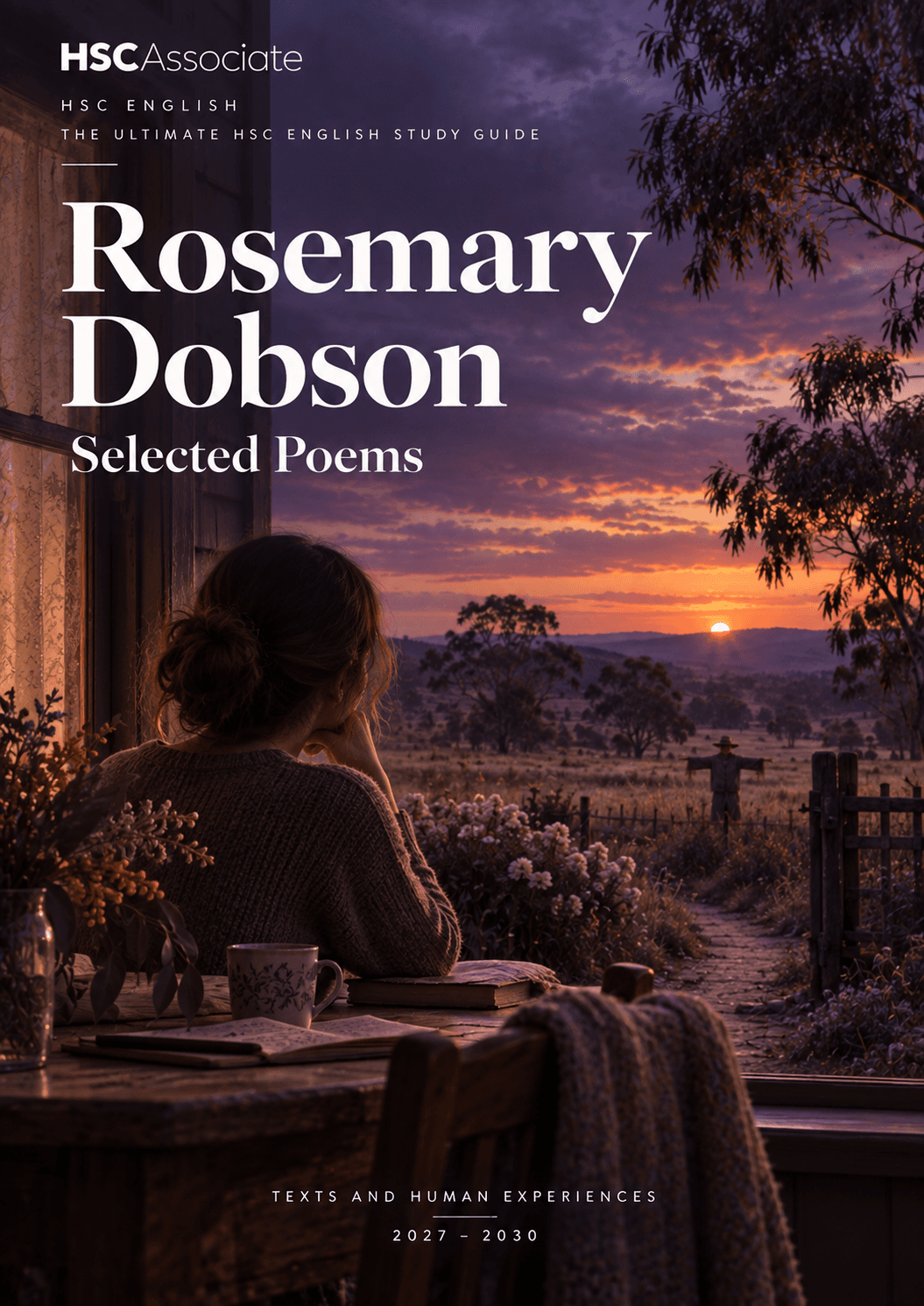
The matching HSCAssociate study guide
Ready to Take Your Rosemary Dobson HSC Preparation Further?
Compare the seven prescribed poems through the ideas and poetic choices that matter most to the question you are answering.
- Find useful connections across the poems.
- Analyse how form and language create meaning.
- Build a sustained argument with carefully explained quotations.
Purchase and existing Reader access are handled on the study-guide page.