HSC English · Study article
Question 7 HSC Analysis: Summary, Themes and Techniques
A study guide to Richard Flanagan's Question 7 for 2027–2030 HSC English Standard and Advanced: summary, themes, form and essay ideas.
On this page
Question 7 Overview
Richard Flanagan's Question 7 is a memoir that asks how one person's life can emerge from events far beyond their control. A father's survival of wartime forced labour, a mother's love, the destruction caused by the atomic bomb, Tasmania's colonial history and the author's own brush with death all enter the same inquiry. The book moves between these histories rather than telling Flanagan's life from childhood to adulthood in order.
For the 2027–2030 HSC, Question 7 is prescribed nonfiction for the Year 12 Texts and human experiences focus area in English Standard and English Advanced. The prescribed Penguin paperback has ISBN 9781761343483. Check the NESA prescriptions and the publisher's edition record when preparing your copy.
A useful starting argument is that the memoir makes personal identity inseparable from inherited stories, historical violence and chance. Its links across time invite thought, but they are not a simple proof that one event mechanically caused the next. Flanagan asks readers to hold the value of a particular life beside the immense loss through which history also moves.
Question 7 Summary
A family story that opens into history
The memoir opens with Flanagan's visit to the site of Ohama Camp in Japan, where his father had been a prisoner of war and a forced labourer in a coal mine. At a local museum, Flanagan finds records of the mine but no photographs of the prisoners. The opening's short numbered sections move between this absence, the bombing of Hiroshima and his father's work beneath the Inland Sea. The father's experience is not just background information; it changes how the son understands his own life. These details can be checked in the publisher's authorised opening extract, which is from an earlier hardback edition.
Wells, West and the imagined chain of causes
The book travels back to the relationship between writers H. G. Wells and Rebecca West and to Wells's novel The World Set Free, which imagined atomic weapons. It then moves through the scientific thinking associated with Leo Szilard and toward Hiroshima. Historical accounts document Szilard's reading of Wells, while Flanagan constructs a more provocative chain between literature, love and catastrophe. Read that larger chain as the memoir's way of testing connections and counterfactuals, not as evidence that a love affair directly caused the bombing. The form makes the reader question how stories about causation are built.
Tasmania and colonial history
Flanagan's attachment to Tasmania includes an inquiry into British colonisation and violence against Aboriginal Tasmanians. He also reflects on the colonial imagination behind Wells's The War of the Worlds, a connection he discusses in an author interview. The place he calls home carries histories that a family memoir cannot set aside. This strand widens the book's scale again: belonging to a landscape can coexist with responsibility to recognise the dispossession and suffering embedded in its history. Avoid reducing Tasmania to a symbol or treating Aboriginal peoples as only part of the past.
The river and a life that might have ended
As a young man, Flanagan is caught in a dangerous rapid on a Tasmanian river. In the memoir, that near-death experience gives physical force to the question of contingency. The prospect of his own death makes survival feel neither guaranteed nor fully explainable. The river episode speaks to the wartime story without equating the two experiences: each asks how a life continues when it might have stopped.
What the ending asks us to reconsider
The memoir ends by a river in Tasmania, bringing its questions about survival and the fragile fact of being alive into focus again. Its distant stories press on one another without settling a single answer about fate. The account of a son's life depends on people he knew, people he never met, imagined possibilities and public catastrophes. A strong summary therefore describes the movement among episodes and the question it creates, rather than forcing the book into a straight timeline.
Studying Question 7 for the HSC? The Question 7 HSC Study Guide helps you turn these connected strands into an evidence-led response.
Major Themes in Question 7
Memory, identity and family love
Flanagan's memories of his parents are acts of interpretation, not a complete record of who they were. By placing remembered intimacy next to historical research and speculation, the memoir asks how a person comes to know a family and a self. Love is both a source of connection and a reason the past remains difficult to contain in a neat explanation. Analyse the difference between what the narrator remembers, what he learns and what he imagines.
Survival, chance and mortality
His father's wartime survival and Flanagan's river experience are dramatically different, yet each exposes the gap between living and the possibility of death. The narrator considers how improbable his own existence may be. That recognition can create wonder, but it also raises an ethical difficulty: gratitude for survival cannot erase the suffering of people who died. This tension gives a stronger essay argument than a simple claim that the memoir celebrates resilience.
War and the afterlife of violence
The forced labour of prisoners of war and the atomic bombing belong to collective history; Flanagan approaches them through the particular life of his father. The book questions how violence continues in family memory after an event ends. Its broad chain of references can make a private relationship feel implicated in the twentieth century without making any single personal story stand for every victim or survivor.
Colonialism, place and belonging
Tasmania is a loved home and a place marked by colonial violence. That double perspective complicates an easy idea of belonging. The memoir's attention to Aboriginal Tasmanian histories asks readers to consider whose experiences are remembered when a nation or family tells its story. In an essay, keep the focus on how Flanagan represents this history and avoid turning First Nations people into a metaphor for his own identity.
Personal and Collective Human Experiences
Question 7 repeatedly changes scale. An individual son reflects on a father; that father's forced labour leads into war; the war sits beside scientific and literary histories; the narrator's memories of Tasmania meet the island's colonial past. The movement shows that a private life can be shaped by collective events, while the personal viewpoint makes the cost of those events felt rather than merely counted.
The book also resists a smooth conversion of public disaster into private meaning. Flanagan presents his father's survival and his own later birth in relation to the bombing, but this is the memoir's account of a possible chain, not a complete historical explanation of why his father lived. The loss of life at Hiroshima remains a catastrophe in its own right. This is a productive paradox for Texts and human experiences: the same event can enter one family's survival story and remain an irreducible tragedy for others. Explain how the narrative's shifts in scale keep both views present.
Nonlinear Form, Narrative Voice and Techniques
Nonlinear structure lets one episode revise another. The memoir crosses decades and continents, then returns to family and the river. In the authorised opening extract, separate numbered sections place a 2012 visit to Ohama beside August 1945, then return to the former camp. That sequence makes the reader construct a relationship between missing public records and a family's remembered suffering. Across the memoir, recurring ideas and associative transitions invite return and reconsideration rather than a finished chronology.
First-person, reflective voice gives the book intimacy but also visible limits. The narrator can recount his own experience, interpret family stories and reconstruct events outside his direct knowledge. Those positions do not carry identical authority. When analysing voice, distinguish a remembered observation from a speculative connection. That distinction is especially important for historical claims.
Allusion and juxtaposition put Wells, West and Szilard beside the father's story. Literature and scientific thought become part of the memoir's inquiry into what ideas can set in motion, while the sudden movement between a large event and a small human scene tests the reader's sense of proportion. Repetition and questioning keep causal and moral answers open; Flanagan asks why people seek one origin story in the opening extract rather than offering a final explanation. He has described the book's composition through dreams, but your essay should still show what the published text itself does. See the publisher's interview and our HSC English literary techniques guide.
Band 6 Thesis Ideas and Essay Arguments
These are original models to adapt to the question, not memorised responses or substitutes for close reading. Add accurately checked evidence from your prescribed copy before submitting an essay.
- Identity and contingency: Flanagan's movement from the numbered Ohama scenes to the river episode presents identity as contingent on lives and events the individual cannot control. Compare the father's forced labour with the narrator's very different encounter with mortality; analyse how the jumps in time connect them without treating them as equivalent.
- Love and ethical tension: Question 7 values family love while resisting a comforting account of wartime suffering. In the opening, a love hotel stands at the former mine entrance and a media crew seeks an image of Flanagan embracing a former guard. Analyse how these scenes interrupt an easy opposition between love and violence, or an easy image of forgiveness.
- Memory and place: By representing Tasmania as home alongside its colonial history, Flanagan makes belonging depend on whose stories remain visible. Connect his reflection on Wells's The War of the Worlds with the memoir's Tasmanian strand; explain how literary allusion broadens a personal account of place into a question about historical violence.
Model analytical paragraph: In the memoir's opening, Flanagan visits the former Ohama camp and finds that a local museum records the mine but lacks photographs of its forced labourers. He then moves, through separate numbered sections, to the Hiroshima bombing and his father's work beneath the Inland Sea before returning to the camp. The juxtaposition makes public absence and personal memory confront one another: the father's survival becomes inseparable from the question of who is remembered at all. When a media crew seeks an image of Flanagan embracing a former guard, his refusal challenges a simple narrative of reconciliation. The form represents a human experience of inherited trauma that cannot be resolved by a public gesture. This paragraph uses paraphrased details from the publisher's authorised extract of the earlier hardback; check wording and page references in the prescribed paperback before using them as essay evidence.
Question 7 and HSC Texts and Human Experiences
NESA calls the current 2027–2030 Year 12 focus area Texts and human experiences in English Standard and English Advanced. “Common Module” is a familiar search term from earlier syllabuses, but use the current focus-area name when planning your response. In Paper 1, the prescribed-text task asks for an extended response; prepare a flexible argument rather than a fixed summary.
For this focus area, the memoir offers individual and collective experiences, emotional complexity, and contradictions in how people understand survival. Choose a question's key idea, make a claim about how Flanagan represents it, and support the claim with distinct episodes and precise analysis of form. For a different prose treatment of memory and relationships, read our Cold Enough for Snow HSC analysis. For another text that connects a single life with exile and belonging, see An Imaginary Life HSC analysis.
Question 7 HSC FAQs
Is Question 7 prescribed for HSC English Standard and Advanced?
Yes. Richard Flanagan's Question 7 is prescribed as nonfiction for the 2027–2030 Year 12 Texts and human experiences focus area in both English Standard and English Advanced.
What is Question 7 about?
Question 7 connects Flanagan's family history and near-death experience with the Second World War, the atomic bomb and Tasmania's colonial past. Its central question is how love, violence and chance shape a life.
What are the main themes of Question 7?
Major themes include memory and identity, family love, survival and mortality, war and colonial violence, and the relationship between individual lives and collective history.
How is Question 7 structured?
It moves nonlinearly among memoir, historical reflection, literary allusion and imagined scenes. Recurring questions and connections let later episodes change the meaning of earlier ones.
How should I use Question 7 in an HSC essay?
Build a claim about a human experience, connect at least two distinct episodes, and explain how Flanagan's structure and narrative voice shape their meaning. Check any quotation against your prescribed copy before using it.
HSCAssociate Platform
HSCAssociate Platform · Writing practice
Preparing Your Question 7 HSC Essay?
Don't just memorise your analysis. Put it into practice with HSCAssociate.
Essay Marker
Submit HSC English essays and receive detailed feedback to improve your response.
English Essay Builder
Develop your thesis, structure your arguments and prepare for unfamiliar HSC questions.
Question 7 HSC Study Guide
This overview gives you a map of the memoir's major strands. The matching HSCAssociate guide supports closer reading, evidence selection and essay planning. The Question 7 Library page shows its current purchase or Reader access options.
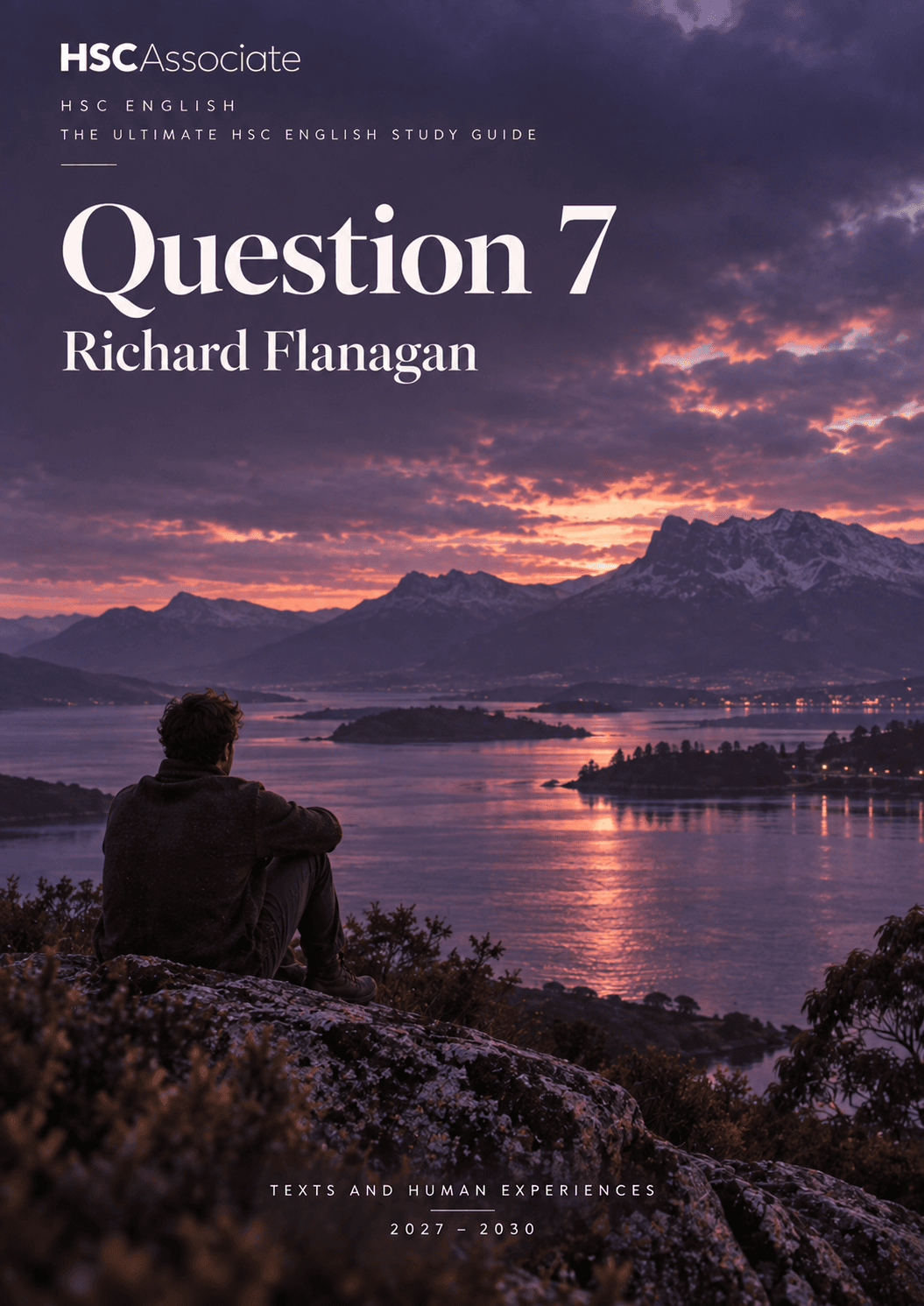
The matching HSCAssociate study guide
Ready to Take Your Question 7 HSC Preparation Further?
Study the relationship between memoir, history and reflection in Flanagan's work, then develop an argument grounded in its form.
- Recognise how memoir and historical material work together.
- Connect reflective form to your interpretation.
- Practise paragraphs that explain evidence in relation to a thesis.
Purchase and existing Reader access are handled on the study-guide page.